This Introduction opens with a small humiliation at a lilong gate – a neighbour asking where the author lived, and meaning far more than an address – and uses that question to frame the book's three interlocking topics: globalisation, the heritage industry, and the economy of urban space. It situates Tranquil Light, the pseudonymous French Concession compound at the centre of the ethnography, inside the longer history of Shanghai's alleyway houses; introduces the two new tides of migrants and creative newcomers who remade lilong demography after the 1990s; and states the book's central surprise: that in the surviving lilong, original residents have often been agents rather than victims of demographic change. Methodologically, it locates the project in Bestor's slow-attention ethnography of urban neighbourhoods and in the author's own path from architecture at MIT to anthropology at Harvard. The chapter map that closes the Introduction previews the seven ethnographic chapters and the conclusion's bridge from Shanghai to citizen-centric smart-city work in southern Thailand.
The first time someone in Shanghai asked me where I lived, I thought it was small talk. We were standing at the gate of an old rowhouse compound in central Shanghai on a hot July morning in 2013, and a neighbour – a retired factory worker with a steel-grey bowl cut and a thermos of green tea welded to his hand – wanted to know which room, in which house, on which lane I had moved into. Then he wanted to know whether the room had a window facing south. Then he wanted to know whether I had my own kitchen, or whether I shared one. Then he wanted to know whether the bathroom was mine, or down the corridor, or two corridors over.[1]
It took me weeks to understand that this was not small talk. He was reading me. With a few quick questions he was running a kind of socioeconomic forensics that, in most places I had lived before, would have required a credit check and a tax return. By the time he walked away with his thermos, he knew almost exactly what I was worth in the local economy of judgment – and, more importantly, whether I was worth introducing to his daughter.
I want to begin this book with that small humiliation, because the rest of what I am about to say in these pages comes from sitting with it for a long time. A house in one of those compounds is not the same kind of thing as a house elsewhere. It is not principally an asset. It is not principally shelter. It is certainly not the abstract object architects draw plans of. It is something stranger: a public document of a private life, bound to the city by a thread that is at once historical, political, romantic, and bureaucratic. To live in one is to be partly transparent. To buy one is to participate in a hundred years of unfinished arguments between the state, the market, and the neighbours. To be asked where you live, in such a place, is to be asked, all at once, who your parents were, what kind of work you do, whether you can afford to marry, and whether you should have left this neighbourhood by now.
This book is about that question, and about the city that produced it. It is also a book about three other things that the question, looked at from a distance, turns out to be a question about: globalisation, the heritage industry, and the economy of urban space. The three are not separate topics. They are the same topic seen from three angles. Globalisation is what the city is performing. The heritage industry is the script of the performance. The economy of urban space is who pays, who is paid, who is moved, and who is allowed to stay. Tranquil Light, the eight-decade-old neighbourhood that the rest of this book lives inside, sits at the intersection. It has been globalised, heritagised, and economised – sometimes by the state, sometimes by the market, sometimes by the residents themselves. What makes it interesting, sociologically, is that the residents are not only objects of those three processes. They are, increasingly, agents of them.[2]
A House Is Never Just a House
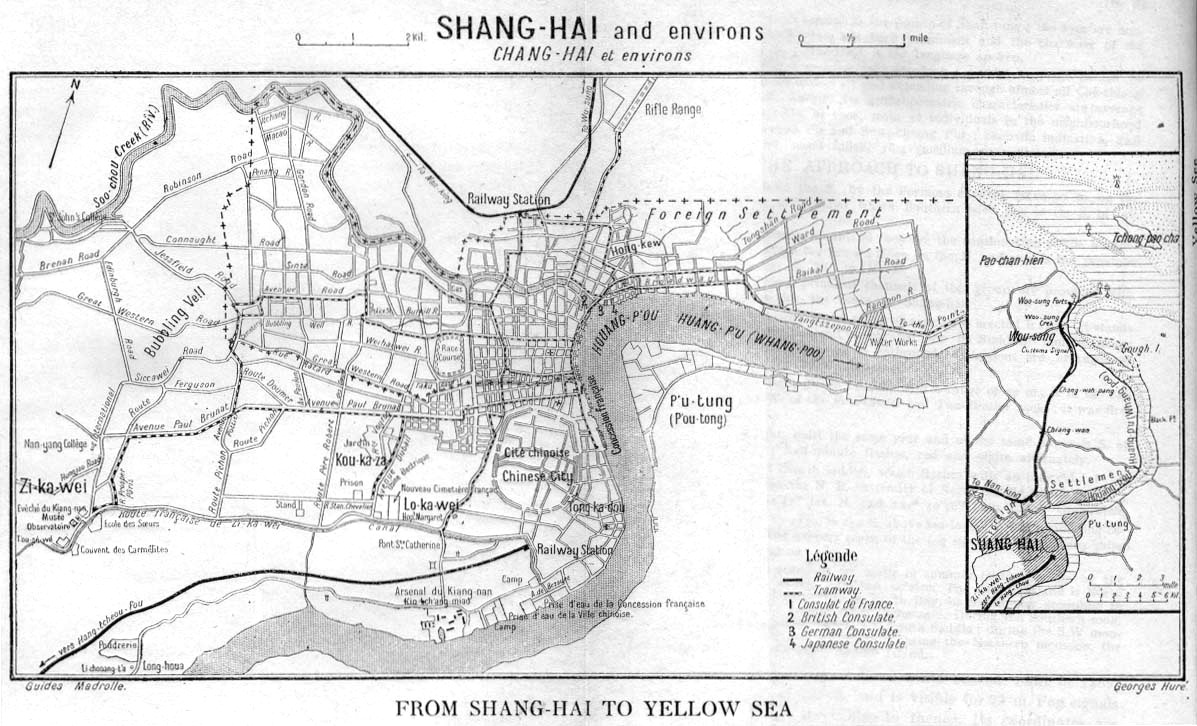
Those rowhouse compounds had a name. They were called lilong. They were a kind of British rowhouse that the British did not build, in a Chinese city that for a century was not entirely Chinese. The form came into being in the second half of the nineteenth century, in the foreign concessions of Shanghai. The city had just been opened to foreign trade after the Opium Wars. It was absorbing a flood of refugees from the surrounding provinces and a sudden demand for working-class housing inside concession boundaries. Speculative builders, many of them foreign, met the demand with a hybrid: long terraces of attached two- and three-storey houses, each with a small front court, organised into closed compounds reached through a single gated lane. The Chinese word for the gate-and-lane arrangement was lilong; the houses themselves came to be called shikumen, after the stone-framed doors that fronted the alleys. By the 1940s, when the Republic ended and the People's Republic was about to begin, the lilong covered something like sixty to seventy percent of the city's footprint.[3] If you have seen an old aerial photograph of Shanghai under the foreigners – the tightly woven grey fabric stitched between the river and the racetrack and the railways – you have seen a city made almost entirely of lilong.
Then the city was made into something else. After 1949, when most of the original middle-class owners fled the new regime, the lilong houses passed into the hands of work units (danwei) and were redistributed as worker housing. The single-family rowhouse was subdivided into rooms for three, four, sometimes five families. Walls were thrown up across what had once been parlours. Cooking moved into corridors. Bathing moved out altogether, to a public bathhouse down the lane. The lilong, which had been built to express a particular kind of capitalist economy – high-density, just barely respectable, with private interiors and semi-public alleys – was reorganised to express a particular kind of socialist economy: shared, dense, deferential to the work unit, hostile to the bourgeois interior. No new lilong were built after 1949. The Party found the typology embarrassing in its inheritance and retrograde in its scale, and turned instead to Soviet-inspired six-storey walk-up apartment blocks, which were quicker to build and easier to allocate.
The houses, meanwhile, kept being lived in. They have continued, more or less, to be lived in ever since.
The economic reforms of the 1980s and 1990s arrived in Shanghai as a wave of demolition. By the time I began doing fieldwork there, more than two-thirds of the lilong had been pulled down to make room for the high-rise apartment blocks that now define the city's central districts and most of its outer ones. Tearing them down was not, at first, a controversial programme. The houses were old and tired. Most lacked private kitchens, most lacked private bathrooms, many leaked, all were crowded. The local government promised modern apartments in exchange. Most residents agreed. Many were relieved.[4]
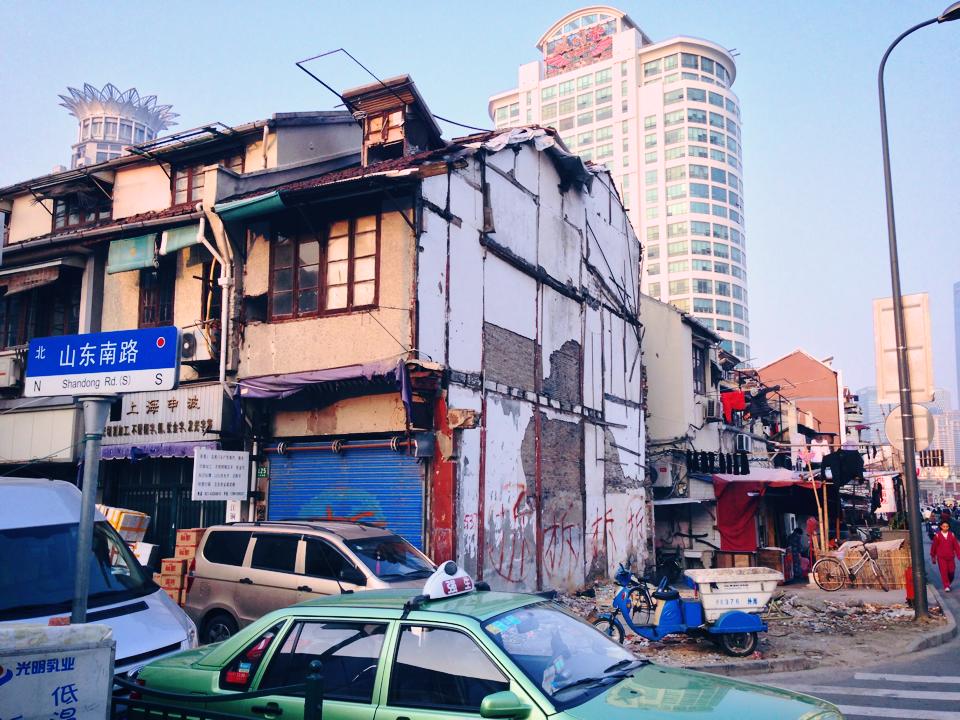
What few people predicted, in those early demolition years, was that the lilong would acquire an afterlife. Around the late 1990s, as Shanghai began to assemble itself into a global city – a competitor of Tokyo and Hong Kong, a stage for the World Expo and the Stock Exchange, a postcard with two skylines – academics and planners began to look at the diminishing stock of lilong with a new word. They started calling it heritage. By the time of my fieldwork, fewer than one hundred lilong compounds were still standing in the city. Each held between one thousand and four thousand residents. Each was now classified, somewhere on a planning map, as a thing the state was supposed to protect.[5]
What protection meant, in practice, was almost always one thing: the façade. The local government invested heavily in cleaning the bricks, repointing the mortar, repainting the doors, hanging new lanterns at the gates. It invested almost nothing in the interiors. While the lanes outside were being made photogenic for tourists and journalists, the rooms inside continued to leak, to lack ventilation, to share toilets with three other families and a sink with five. The phrase residents used for the official programme was ‘beautification' (meihua).[6] They said the word with the exact tonal flatness that English-speakers reserve for ‘rebranding.'
This is the contradiction the book wants to sit inside, not solve. The lilong is at once the most loved and the least livable kind of housing left in Shanghai. It is what the city advertises about itself and what the city is trying to leave behind. Ten-million-yuan apartments rent the back rooms of houses that share a single squat toilet. The same pavement that hosts the morning queue for the public sink will, by mid-afternoon, be photographed by an art director from Paris. The residents are not confused about any of this. They use the contradiction. They live inside it. They make money off it. They sometimes lose everything to it. This book is an attempt to follow them through what they made.
Heritage or Home?
Around the corner from where I lived for most of my fieldwork, there was a lilong house that had been split, sometime around 1955, into four separate dwellings on three floors. By 2013, those four dwellings had become six. The front court had been roofed over and turned into a kitchen, then a bedroom, then – when one of the children grew up and married – half a bedroom and half a hallway. The roof had been pierced by a stovepipe, then patched around it, then pierced again. The single original bathroom had been replaced by a half-bathroom on the ground floor, behind a door that did not quite close, with a curtain that did. There was a sign at the entrance to the alley, posted by the district government, identifying the compound as a Protected Building of the Third Category. It listed the year of construction, the architectural style, and the cultural significance of the typology. It said nothing about who lived inside, or how, or what they paid for the privilege.[7]
I want to use that small fact – a sign about a building, silent about its inhabitants – to introduce one of the book's main claims. The category of heritage, as it has been used in Chinese cities over the last twenty years, has functioned to displace the question of housing without actually answering it. ‘Heritage' has allowed the local state to perform care for the lilong while continuing, almost unchanged, the policies that make life inside them difficult. ‘Heritage' has allowed academics like me to talk about the lilong as if it were a single, unitary object – a piece of urban culture, a typology, a tradition. Each compound is, in fact, a tangle of legal claims, generational arrangements, informal subdivisions, and competing futures. ‘Heritage' has allowed visitors and journalists to admire the lanes without ever entering a kitchen. It has allowed developers to sell the aesthetic of the lanes without preserving the social arrangements that produced them.
I do not say this to scold the heritage industry. The work many preservationists are doing in Shanghai is real. Some of it has saved real buildings that would otherwise be gone. I say it because the people I lived among did not, by and large, experience their houses as heritage. They experienced them as a complicated kind of leverage. The fact that the building was protected meant that they could not be evicted as easily as their neighbours in the surrounding blocks who lived in plain concrete walk-ups. The fact that the building was photogenic meant that they could rent out a back room to a young foreigner for two or three times the rent of a comparable space elsewhere. The fact that the building was old meant the local government was reluctant to invest in real renovation, because real renovation might compromise the heritage status. So they made do. They leveraged. They kept the curtain over the bathroom door.[8]
Heritage and housing, in other words, are not two stages of one policy. They are two ways of making competing claims about the same physical structure. The state would like the lilong to be heritage. The residents would like it to be housing. The young entrepreneurs renting back rooms would like it to be aesthetically heritage and functionally housing, with the bills paid by a third party they have not yet met. The migrant family from Anhui sleeping four to a room in a partitioned tingzijian – the small, north-facing pavilion room over the stair landing, originally designed for a maid – would like it to be cheaper. Each chapter of the book takes one of these competing claims and follows it down the lane.
Two New Tides
Two groups of newcomers have, over the past two decades, transformed who lives in the surviving lilong. The first is the floating population (liudongrenkou) – rural migrants who together make up something like a third of Shanghai’s twenty-four million residents.[9] Without a Shanghai household registration (hukou), they do not have ready access to the city’s schools, hospitals, or subsidised housing. They come for the work, which is almost all of it: factories on the outskirts, restaurants on the corner, construction everywhere. They live where they can afford to, which is increasingly the back rooms and stairwells of dilapidated lilong houses whose original owners have left for a more comfortable apartment in Pudong.
The second is harder to name in a single phrase. They are the small entrepreneurs, the boutique owners, the freelance graphic designers, the second-novel novelists, the bartenders with master's degrees, the foreigners who came on a one-year teaching contract and stayed for nine. Some are local Shanghainese who could afford to live elsewhere but want to live here. Some are non-local Chinese who arrived from Beijing or Chengdu in their twenties and made the lilong their first Shanghai address. Some are foreigners who, like me, fell into a particular kind of love with the form. In Chapter Six I will call them, more clinically, residents engaging in the value-added entrepreneurial economy, because that is what the local state began calling them when it decided to crack down. For now I will call them what their neighbours called them: the new ones.[10]
The two groups do not, on the surface, have much in common. The migrants are precarious in a way the new ones are not. The new ones are visible in a way the migrants are not. But both groups, from the perspective of the original residents – the retirees who were given their rooms by the work unit in 1978 and have lived in them ever since – are sources of rent, and therefore sources of survival. With the slow erosion of the iron rice bowl (tiefanwan), the lifelong package of work-unit benefits that used to underwrite the older generation's old age, that rent has become more than supplemental. For many of the elderly residents I came to know, the few hundred or few thousand yuan they could pull each month from a back room rented to a graphic designer or a delivery driver was the difference between paying for a chronic illness and not paying for it.[11]
What I did not expect, when I began the fieldwork, was how much the original residents had come to depend on these newcomers in ways that went beyond rent. The new ones helped with the smartphone. The new ones explained how WeChat Pay worked. The new ones, sometimes, helped a grandchild with English homework, or stood in line at the household registration office for a paperwork errand. There was friction too – drinking too late, talking too loud, leaving the front gate open – and there were quiet, patient resentments about who got what kind of foreigner, who could charge what kind of rent, whose nephew had cleverly installed himself as a sublessor of his aunt's room while she had moved to Pudong. The neighbourhood, like all neighbourhoods, was a careful arithmetic of grudges and obligations. But it was an arithmetic these old residents seemed, on balance, to prefer to the alternative, which was the high-rise apartment in a peripheral district with no neighbours at all.
This was the surprising thing. Almost everywhere else I had read about it, gentrification produced loss. The original residents were displaced; the neighbourhood was rebranded; the rent went up; the old people died alone in a far block. In the lilong I was living in – and as far as I could tell, in most of the surviving lilong in central Shanghai – something different was happening. The original residents were not being displaced. They were renting out rooms while staying in the same house, or they were renting out their whole house and using the income to live more comfortably in a peripheral apartment that they liked, with the option of returning whenever they wanted. They were, in a phrase I will return to in Chapter Five, gentrifying themselves. They were the agents of the change. They were the ones, mostly, who profited from it. And the diversity of their houses – old retiree, young migrant, foreign designer, Shanghai-born returnee from London – was higher, not lower, than at any moment in the postwar history of the building.[12]
This book is partly an attempt to take that surprise seriously. I do not want to claim that the lilong story is universally good news, or that the residents are uniformly winners, or that the structural inequalities of the Chinese housing system have been solved at the alley level by clever grandmothers with spare bedrooms. They have not. There are losers. There is real suffering in these chapters, particularly in Chapter Seven, where I follow a young man who very much loses. But the dominant narrative I had inherited from the literature – the one in which the urban poor are passively crushed by globalising capital – did not match what I was seeing in the lane. So I tried to look more carefully.
Locating Shanghai
I called the dissertation that became this book Locating Shanghai. I want to spend a moment on the word locate, because it is doing more work than it appears to be doing.
The dictionary definition is the obvious one: to find or fix the position of something. The slightly less obvious one is the active one: to set up, to install, to put in a particular place. Both of these meanings matter for what I am doing in this book. I am trying to find Shanghai – to fix its position, in the sense of describing what kind of city it actually is, away from the postcards. And I am trying to locate it in the second sense, by following its residents to the actual places where they actually live, and by treating those places as if they were the city. The skyline of Pudong is not, for the people in this book, where Shanghai happens. Where Shanghai happens is in a particular alley, on a particular afternoon, between a particular landlord and a particular tenant.
This is not original to me. The anthropologist G. William Skinner argued, more than fifty years ago, that the social patterns of a Chinese place could not be understood independently of their spatial logic.[13] Where people lived, where they shopped, where their kin lived, where they were buried – these spatial patterns were not the consequence of social life but the structure of it. Skinner was writing about rural marketing systems, not city neighbourhoods, but the underlying claim translates: if you want to understand who someone is, you need to know where they are. The habit of treating space as backdrop, and people as the figures painted onto the backdrop, is one of the things ethnography is supposed to cure.
Cities, in particular, resist that habit at their peril. Most of the pieces of writing I have ever loved about cities – Jacobs on the West Village sidewalk, Whyte on the Boston street corner, Bestor on a Tokyo neighbourhood, Wirth on urbanism as a way of life – share a single methodological intuition.[14] The texture of a city is the texture of its small, repeating spatial encounters. The bench. The corner. The lane. The shop. The stairwell. You cannot get to the social by jumping over the spatial. The spatial is the social, in a particular medium, at a particular grain.
Shanghai resists this kind of attention because Shanghai changes too fast. I went back nearly every year for a decade between 2006 and 2016, and I was never able to find the same city twice. A coffee shop I had loved for a year would be a 7-Eleven by the next visit; a block I had photographed extensively would be a hole in the ground; the hole would be a high-rise. I have read the philosopher David Hume on personal identity – the famous passage about how, when he tries to enter most intimately into what he calls himself, he stumbles only on perceptions, never on a unified self – and I have thought, often, that Shanghai works the way Hume thought selves worked. There is no underlying Shanghai-substance that persists through these changes. There are only the changes, joined into a sequence by an interpretive habit. To insist on a stable Shanghai is to commit a category error. To follow the changes, in their actual locations, is the only available method.[15]
What I have tried to do in this book, then, is to slow Shanghai down in one place. I have called the method, in earlier work, anthrotecture – a clumsy coinage for a serious habit, the habit of treating built environments as practices rather than as objects, and of treating ethnography as the right discipline for asking what those practices are.[16] I picked one neighbourhood – I will introduce it in a moment – and I lived there. I rented a room in a lilong house and I stayed in it for sixteen months, and then I moved to a high-rise on the edge of the same district where some of my informants had moved, and I stayed there for another twenty months. I sat at the gate. I went to the market with the neighbours. I drank too much yellow wine. I lost three rounds of mahjong a week. I asked a thousand questions about who lived in which room and why, and I wrote down the answers, and I asked the same questions a year later and wrote down those answers too. The thing about a city that refuses to sit still is that, if you sit still inside it, eventually it shows you how it moves.
‘Locating' is the verb the book uses for that sitting still. It is meant in part as a methodological insistence – that I am writing this from a particular floor of a particular house in a particular alley, not from the planning bureau or the press release. And it is meant in part as a political insistence – that the Shanghai of this book is the city that is occupied, lived, and experienced, by its actual residents, and not the Shanghai of the airport postcard with two skylines.
I keep that postcard, by the way. The Tourism Authority of Shanghai gave it to me on my first visit, in the summer of 2006, and I have kept it for almost twenty years, mostly because every time I look at it I feel a small, useful scepticism. The postcard shows the Bund and Pudong across the Huangpu River, the most photographed five hundred metres of urban frontage in modern China. It is real. It exists. It is also a lie of omission so total that it would, if it were a person, be unable to make eye contact. Twenty-four million people live in Shanghai. Not one of them lives on the postcard. This book is, in a small way, an attempt to put some of those twenty-four million back into the picture.
Marriage, Money, and a Roof
Halfway through my second year in the field, a man I had been talking to for several months invited me to lunch and told me, with considerable cheer, that he did not deserve any of his money. He had been given a one-room apartment by his work unit in the mid-1980s. He had lived in it for fifteen years. In the early 2000s, when the local government cleared his block to build a row of high-rise residential towers, the developer had paid him just under three million yuan in compensation – about half a million U.S. dollars at the time – for a unit he had never paid a yuan to acquire. He had reinvested the windfall in the rising real estate market and was now collecting rent on three apartments. ‘To tell you the truth,' he told me, smiling, ‘I don't think I deserve any of this money. I didn't work hard for it at all.'[17]
There are a hundred ways to feel about a sentence like that. The one I want to draw your attention to is structural. He was right. He had not worked for it. He had been, in the language of the literature, lucky to be in Shanghai at the right time. And the local cohort who were lucky in the same way – who happened, through no plan of their own, to hold a work-unit apartment when the demolition arrived – had been, in a single generation, transformed into a class of small landlords. They were not rich by global standards. They were, by the standards of their own parents, unimaginably comfortable. They knew this, and most of them were a little embarrassed by it, and some of them – like the man at lunch – said so out loud.
Behind that lunch, however, sat a much harder structural problem. For everyone who had been lucky in this way, there was someone who had not been. There were locals who had failed to lose their housing at the right time, and who therefore continued to live in deteriorating apartments without the cash cushion to buy their way out. There were the migrants I have already mentioned, who could not legally buy property in the city at all without a hukou. There were the children of locals – the second-generation Shanghainese now of marriageable age – who could not, on their salaries, afford to buy a single square metre of central-city housing without their parents' direct, large, and often complete financial assistance.
This last fact has done more to shape contemporary Shanghainese family life than almost any other policy variable. To get married in this city, in 2026 as in 2013, you essentially need a flat. Not a flat in some abstract future sense; a flat now, in your name (or your fiancé's name), with the title certificate in a drawer. The house comes before the wedding the way the wedding once came before the children. And because the price of a flat is, for most young people, twenty to forty times their annual salary, the money for the flat comes from somewhere else. It comes, almost invariably, from the parents.[18]
This is what people in Shanghai mean when they tell you that housing is the problem. They do not mean that there is too little of it. They mean that the institution of marriage, the institution of inheritance, the institution of the family, the institution of the local hukou, the institution of the school district, and the institution of the central bank's interest rate policy, have all been threaded through the eye of the same physical needle – a key, in a lock, in a door, on a particular street. Pull on any of those institutions and the others move. The young man on the marriage market is not exaggerating when he says, in his profile, that he owns. The mother in the marriage corner of People's Park is not posturing when she puts the size and orientation of the family flat at the top of her son's biographical sheet. The retired neighbour at the gate of the lilong, asking me whether my window opened to the south, is not making small talk. They are all reading the same document.
Chapter Seven of this book is about a young man named Mr. Zhao who tries, and largely fails, to acquire that document. I follow him for two years through a series of strategies – a planned hunfang (marriage flat), an attempted purchase, a relocation, an eviction, a quieter version of the same plan. He is, by the end of the chapter, neither married nor housed. I want to flag that chapter early, here in the introduction, because the entire structure of feeling I have just described – the cheerful sixty-year-old at lunch, the embarrassed beneficiary of a structural windfall – looks very different from the ground floor of his story. The same housing system that made an accidental landlord of one Shanghainese man in 1985 has, in 2014, made a sleepless and financially ruined fiancé of another. To talk about housing in Shanghai without holding both of those people in the same frame is, I will argue, to fail to talk about Shanghai at all.
How I Got Here
The first time Shanghai entered my life, I was a child sitting on my father's lap in our living room in northeastern Thailand, watching a Hong Kong television series called Shanghai Bund. The show – Shanghai Tan in the original, dubbed into Thai for our broadcast – was a 1980 Cantonese gangster epic starring Chow Yun-fat, Ray Lui, and Angie Chiu, set in the city's foreign-concession heyday in the 1920s. I had no idea what foreign concessions were. I had no idea what the 1920s were. What I understood, watching, was that Shanghai was a place where a young man with a gun could become a hero simply by crossing a small canal. On the other side of the canal there was a different police force, different uniforms, a different court, even different tram tracks, and a different set of rules about which crimes counted. The show's protagonist was a literati from Peking University who had been kicked out for a failed political protest – something about a treaty, something about Versailles, something about how China had sent soldiers to help the Allies in the First World War and been repaid with the surrender of more of its own territory to Britain and France. I did not understand any of that. I understood that there was a city somewhere where a young man could lose an argument with the world and still build a life out of the losing.
What I did not know, sitting there on my father's lap, was that he was secretly studying Mandarin out of a small book he kept tucked away. He had grown up speaking a southern Chinese dialect and had been pushed, in his Thai schooling, into Thai as a first language. Mandarin he had never learned. The book was a quiet attempt, on his own, to recover something a state had asked him to give up. We never spoke about it. He was already gone, decades later, before I could ask him whether the Mandarin in that book was the Mandarin I had since picked up in Shanghai's alleys, or some other Mandarin, of some other Shanghai, that he had been carrying with him the whole time.[19]
The lineage that produced this household was particular. My maternal great-grandparents came from Shantou, in the Teochew-speaking part of Guangdong province, and settled in northeastern Thailand sometime in the late nineteenth or early twentieth century. The exact addresses of their old houses in China are inscribed, even now, on their tombstones in our family's hometown up there – a record of a place none of their descendants can point to on a map. On my father's side, my grandfather was, on paper, born in China; in fact he was born in Thailand, and his paperwork was rearranged at the time so that he would not have to serve in the Thai army. My father's first language was a southern Chinese dialect, almost certainly a variant of Teochew. In his school years, during the strongest decades of Thailand's anti-Chinese sentiment, he was given a Thai name and pushed into Thai as a first language. By the time I came along, he answered to that Thai name, drank his coffee at a Thai breakfast table, and watched Hong Kong gangster shows in Thai dub – a man whose Chineseness had been pushed mostly underground, where, as I would only learn after he was gone, he had kept a small private archive of it for himself.
By the time I reached my twenties, the Shanghai of those Saturday afternoons had retreated into the kind of memory one is faintly embarrassed by. China, when I thought about China at all, was a place I did not feel competent to think about. It was geographically large and emotionally remote. I had been trained as an architect. I expected my professional life to take place in Bangkok, perhaps in Singapore, perhaps in some loose orbit around Tokyo.
In 2005 I arrived at MIT as a Fulbright scholar, with one goal and almost no English. I wanted a degree in History, Theory, and Criticism of Architecture. I wanted, more specifically, to learn how to talk about buildings the way the people I admired talked about them – slowly, abstractly, with reference to texts I had not yet read. Most of my classmates found my interest in HTC strange. I had decent practical skills – I could draw, I could build a model, I could render – and the programme I had chosen had famously little to do with any of that. I knew this. I had chosen the programme in part because it had little to do with any of that. After five years of professional architecture school in Thailand, I wanted to read books. I wanted, in a phrase I am slightly embarrassed to use now, to be unencumbered by reality.
Reality returned in the form of a recruitment session for a workshop I had no intention of attending. A classmate had heard about a joint studio between MIT and Tsinghua University in Beijing, focused on a residential and transit site in a neighbourhood that would soon be transformed by the 2008 Olympics. The session was on a Thursday evening in the middle of midterms. I was reading, badly, for an HTC pro-seminar; I needed an excuse to leave the library; I went.
I remember the slides more vividly than almost any image from my graduate education. They were not slides of monuments. They were slides of hutongs and courtyard houses, of crumbling brick walls, of overhead electrical wires bunched like nerves at every intersection, of a city in the middle of a kind of municipal seizure. Image after image of the Beijing nobody had put on a postcard. I had thought of Beijing as the Forbidden City. The slides were of what the Forbidden City was surrounded by, and what was being demolished to extend the metro to it. By the end of the session I had decided to apply. By the end of the term I had been selected. By the end of the workshop I had decided that I was going to stop reading about abstract buildings for unspecified people and start trying to understand actual buildings for actual people, which is a different kind of project.
The workshop began in Shanghai. I had never been there in waking life – only in the dubbed Cantonese of a 1980 gangster show I had not thought about in twenty years. I came down the elevated highway from the new airport at Pudong with my face pressed to a coach window, and I was, briefly, the kind of stupefied that I imagine most people are the first time they see the Shanghai skyline. The skyline did not stay interesting for long. What stayed interesting were the smaller things at street level – and, in particular, the lilong. We visited several. I noticed, even on a one-week reconnaissance trip, that the lilong was doing something at the urban-design level that the other typologies in the city were not doing. It was producing a public life. The alleys were being used. People were sitting in them. People were cooking in them. People were brushing their teeth in them. People were, I would later learn to say, performing community in them. I went back to Beijing and proposed that we use the lilong as a kind of conceptual reference for the housing component of the Tsinghua-MIT site. The proposal was well received. The studio ended. I went home to Cambridge with a problem.
The problem was that I did not know how to think about what I had seen. The architectural training I had – including the HTC training I had chosen so carefully – had taught me to describe buildings as objects. It had not taught me to describe buildings as practices. It had taught me to think about form, scale, ornament, history. It had not taught me to think about why a particular grandmother walked her caged bird to a particular corner of a particular alley at six-thirty every morning, or why the corner shop held its tobacco at the front and its alcohol at the back, or what it meant that the third house on the left always had its door open and the third house on the right never did. There was a whole register of evidence I had no vocabulary for, and no method to gather, and no one at MIT – at least no one I had yet found – to help me ask about it.
What I found, slowly, was anthropology. I did not find it as a clean discipline; I found it as a corrective. I started reading ethnographies as much as I read architectural theory, and at some point during my second year I admitted, first to myself and then to a few patient friends, that I had been reading ethnographies the way I once read fiction – for the texture of the world they rendered. I did not have a clear academic plan. I had a research direction, which was Chinese cities, and a methodological hunger, which was for a way of writing about places that did not pretend that buildings were silent. So I went back. I went back the next summer, and the summer after that, and most summers after that, and at some point the visits stopped being summers and became years. I picked up enough Mandarin to eavesdrop, and then enough to argue, and then enough to be argued with. I left architectural practice. I enrolled, eventually, in a doctoral programme in anthropology, and I began the long return to Shanghai that produced the book you are now reading.
I want to mention one detail about that doctoral programme, because it is part of why this book exists. The first day of my first anthropology class was September 2010. I had been in my seat for about an hour when my brother sent me a text message that I did not see until the class ended, because I had silenced my phone. The text said our father had died that morning, in Bangkok, while I was in Cambridge learning how to draw a kinship chart. My father was the person who, more than anyone, had pushed me to apply for scholarships, to go abroad, to ask the questions a young Thai man of his generation was traditionally not encouraged to ask. He was also the person, I now know with a clarity I did not have at the time, who could have told me most of what I have since spent fifteen years learning about my own family – the dialect, the village, the paperwork forged for his own father, the names that had been changed and the ones that had not been. He had, in fact, been quietly editing my earliest writing about all of this. In my undergraduate years at Thammasat I had begun publishing small articles in the university's journal – short pieces about Chinese-Thai identity, about Shanghai, about the films we used to watch on Saturday afternoons. He had read every draft. He had made careful, sparse suggestions in a steady hand. He had never once told me about the Mandarin book in the kitchen drawer. The first day I crossed the threshold into anthropology was the day the most important informant I would ever have had in this discipline became unavailable to me. There is a kind of irony in that I have stopped trying to write around. It is one of the reasons the book you are reading is so attentive to what older neighbours say about their parents and their grandparents and their houses. I am, in part, doing my homework late.
I want to flag a debt here, because the chapter map below will not have room for it. The single person at Harvard who taught me how to do the kind of work this book represents was Theodore C. Bestor. I had, as it happened, been reading Ted long before I met him. At MIT, in the HTC track, I had taken a course with the historian John Dower, who introduced me to a Japan I had not expected – a country he described with the same patient attention that good ethnographers extend to small lives.[20] Through Dower I became fascinated with the kinds of urban spaces almost no one writes about because almost no one looks at them: love hotels, in particular, on which I once wrote an ethnographic essay that ended up in an edited volume. Through love hotels I came to Bestor's Neighbourhood Tokyo and his Tsukiji: The Fish Market at the Centre of the World.[21] Those two books, more than any others, taught me what a city looked like when it was being looked at slowly, by someone who lived in it. It was Ted, years later, who told me in something close to those words that the city was wherever I was sitting in the city. He died in May 2024. The dedication at the front of this book is for him.[22]
Tranquil Light
The neighbourhood I lived in for the sixteen-month core of the fieldwork I have given the pseudonym Tranquil Light. It was built between 1928 and 1932 on a block in what was then the heart of the French Concession, in a style that the surviving plat books call ‘crescent terrace.' One hundred and sixty-three three-storey townhouses around a perimeter, with twenty mixed-use commercial units lining the street side. A directory published in 1932 by Foreign Commercial Press – the so-called Hong Book, a kind of Burke's Peerage for Shanghai's mostly foreign upper-middle-class – gives the population at completion as roughly five hundred. By 1949, after the houses were nationalised and subdivided for worker occupancy, that figure had nearly tripled. By the time I arrived in 2013, the official register listed 3,172 long-term residents, of whom 438 were not local. I was one of those 438.[23]
I will not pretend the fieldwork was anything but slow. The compound's neighbourhood committee (juweihui) was helpful but cautious; the data they shared had to be cross-checked against district almanacs that, in turn, contained gaps for the entire 1949–1999 period and inconsistencies thereafter. The number of households, the almanacs said, varied between 1,280 and 1,558 across the late 1990s and 2000s. The headcount fluctuated between 3,893 and 4,423. The committee told me the volatility was an artifact of registered versus actual residents, but the more granular data – the registered short-termers, the unregistered short-termers, the sublessors, the sub-sub-lessors – was held only by the government. I did the best I could with what I could see. I will return throughout the book to particular households inside Tranquil Light, particular lanes, particular arguments at particular gates.
Tranquil Light is a real place; the people in it are real people; the things that happen in it really happened. The names have been changed. The lane has been moved by a few hundred metres. The compound is recognizable to anyone who knows the district well enough to recognise it, and unrecognizable to anyone who does not. I have done what I could to protect the people who let me sit at their gates and ask uncomfortable questions for sixteen months and counting. Where their stories required composite treatment, I have flagged it.[24]
What's Ahead
The book has seven ethnographic chapters and a short concluding essay. They can be read in order; they can also be read singly. Each is built around a particular lane, a particular argument, and, in most cases, a particular person whose life I followed long enough to know better than I know most of the people I went to college with.
Chapter 1, ‘A Community at the Centre of the World,' introduces Tranquil Light as both a place and a typology. It traces the origin of the lilong as a building form, sets the compound inside the longer history of Shanghai's foreign concessions, and asks the question that will recur in every subsequent chapter: how did this short-historied, foreign-designed, working-class typology become the official architectural symbol of the city's Chineseness? The answer, here as throughout, is partly historical and partly performative. The lilong was made into heritage because the city needed something photogenic. It was made into Shanghainese because the city needed something local.
Chapter 2, ‘Traditionalism as a Way of Life,' follows three residents – a retired local schoolteacher and his wife, a Western expatriate who has lived in the compound for a decade, and a young migrant from Anhui – and shows that all three rely on a similar performance of tradition to stabilise their socioeconomic lives. The three of them mean entirely different things by ‘tradition.' All three of them are using it to make rent.
Chapter 3, ‘A Sad Trope,' is the most physically descriptive chapter. I take you inside the room I rented – the tingzijian, the small, north-facing pavilion room above the stair landing, originally designed for a maid – and I describe, at the grain at which it was actually being lived, the daily life of the building. What it sounded like at six in the morning. What it smelled like in the kitchen. Who knocked when. What the rules were, written and unwritten, governing the use of the shared sink and the shared toilet and the shared landing and the shared roof. The chapter takes its title – and a small homage to its method – from Tristes Tropiques, which was in part an admission that anthropology is, from the inside, often a sad business.[25] I think it is. I also think it is the most honest business available to anyone who wants to write about a city.
Chapter 4, ‘Street Corner Society and the Anthropology of Displacement,' is about how residents fight back. It builds on Whyte’s old image of the corner as a site of social organisation, and on earlier work I did with Matthew Williams on mobility and displacement in the same neighbourhood.[26] It argues that the lilong's corners – the gates, the landings, the fixed benches at the mouth of the alley – are where the residents' political knowledge gets transmitted. Far from being passive recipients of state power, the residents I lived among were experts at the particular art of strategic visibility, of letting the local government know exactly which forms of displacement could be accomplished at what political cost.
Chapter 5, ‘Middleclassification,' proposes a concept I have been working towards for a decade. What is happening in surviving lilong neighbourhoods is not classical gentrification – outside capital pushing original residents out. It is a particular kind of self-gentrification, in which the original residents themselves act as the agents of class reshuffling.[27] Rather than producing a homogenising middle-class enclave, the process produces, at least so far, a neighbourhood that is more, not less, mixed than at any time since 1949. The chapter argues that this particular variant of gentrification deserves a more neutral analytical treatment than it has received in the literature, and offers ‘middleclassification' as a placeholder term until something better comes along.
Chapter 6, ‘The Rise and Fall of the Value-Added Economy,' tracks the brief flowering and rapid suppression of small entrepreneurial businesses – boutiques, bars, design studios, cafés – in a residential lilong neighbourhood. It is the most institutional chapter. It follows the local government's slow, ambivalent decision to crack down on businesses it had earlier encouraged, and it argues, building on work I have done elsewhere on the politics of heritage tourism, that the crackdown was less about the businesses themselves than about a quieter politics of who gets to benefit from the appreciation of heritage real estate.[28]
Chapter 7, ‘The Meaning of Being a Man,' is the chapter that haunts me most. It follows Mr. Zhao, the young man I introduced earlier, through his attempts to acquire a marital flat. It is about housing as the condition of becoming a person – specifically, of becoming a marriageable man – in contemporary Shanghai. It is, more than any other chapter, the one that taught me the costs of the housing system whose virtues I sketched in earlier chapters. It is also where the book lets itself, at last, get sad on the page.[29]
The conclusion gathers the threads. It does not offer policy recommendations, although it gestures towards several. It does suggest that what the lilong has to teach planners and policymakers – in Shanghai and in cities elsewhere that face their own versions of these arguments – is something the residents have known for a long time. They have known that they are not supposed to be passive in the face of urban change. They have known that they are, themselves, the agents of the change, as long as they are paying attention. They have known that a house is never just a house.
The book closes with a brief reflection on how the lessons of Tranquil Light travelled with me, after I left academia, into the citizen-centric smart-city work I now do for the Thai government.[30] The residents of a flooded provincial city in southern Thailand have been teaching, in a different language, to a different state, almost the same lesson the residents of Tranquil Light have been teaching for two decades: that the people who live in a city are usually better at reading the city than the institutions that try to manage it.
I will end with a small invitation. If you are reading this book in a library, somewhere far from Shanghai, I want you to imagine, while you read it, the particular kind of room I was working in for most of the time it was being thought about. Imagine a room about three metres by four. Imagine a north-facing window that does not quite close. Imagine a fluorescent tube overhead, a kettle on a low table, a stack of fieldnotes in the corner, the sound of someone else's mahjong game two walls away, and the smell of someone else's dinner from one floor down. Imagine a knock at the door, and imagine that, when you open the door, the neighbour with the steel-grey bowl cut and the thermos of green tea is standing on the landing. Imagine that, before you have a chance to say good evening, he has already started asking you where you live.
This is a book about that question, and about everything that ended up being inside it.