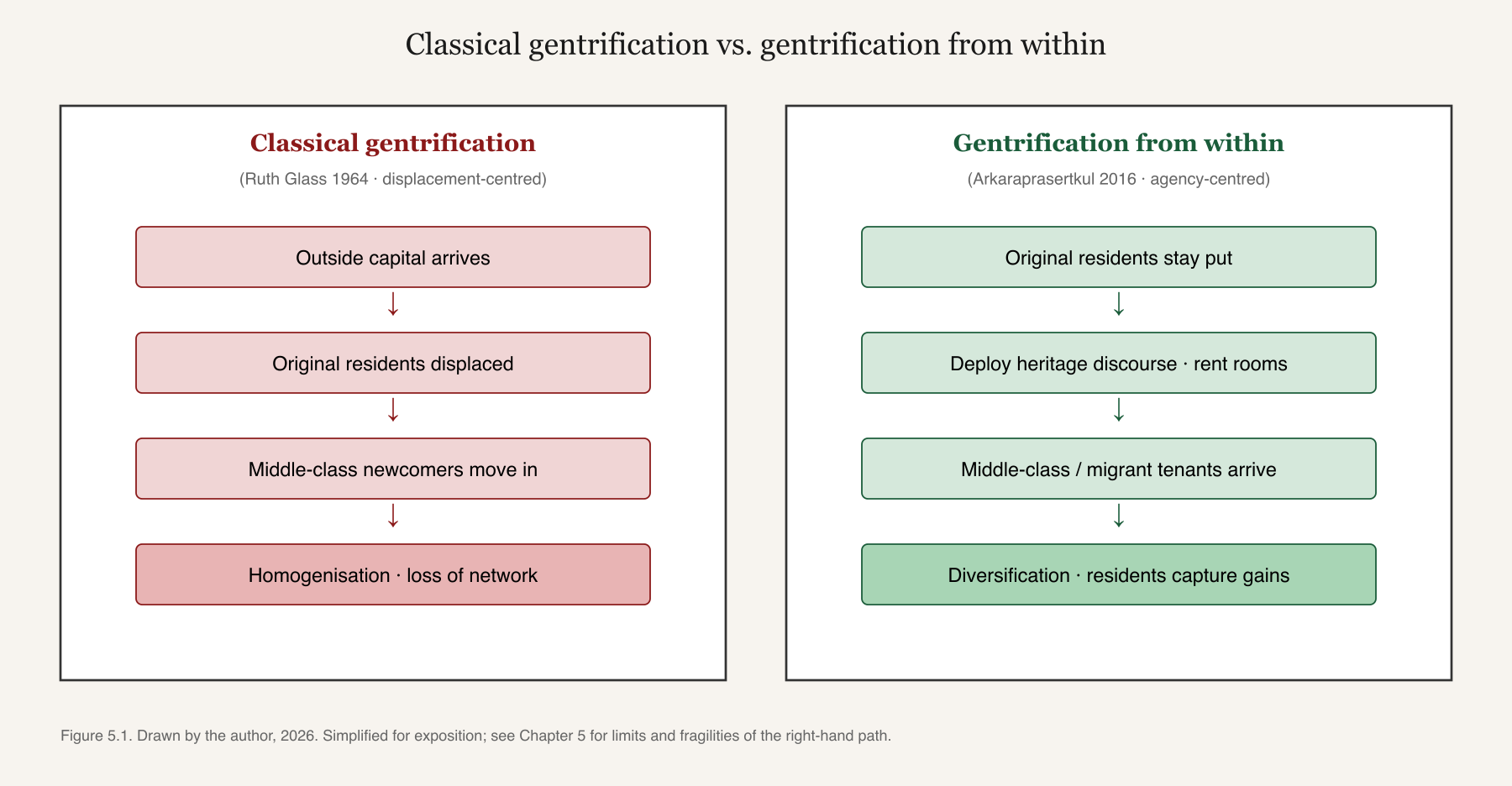
This chapter develops the central theoretical contribution of the book: a concept I have called, in earlier work, ‘gentrification from within’ and refined as ‘gentrification and its contentment,’ and that I translate here, after the Mandarin term residents themselves use, as ‘middleclassification’ (zhongchanjiejihua). The chapter argues that the demographic change underway in Tranquil Light is not classical gentrification – outside capital pushing original residents out – but a particular kind of self-driven class reshuffling, in which the original residents themselves act as the agents of the change. They rent rooms to migrants and to expatriates for the income; they keep ownership; they remain in the compound; the resulting demographic mix is, paradoxically, more diverse than at any moment in the compound’s post-1949 history. Through the case of Annette, the prototype foreign tenant of the mid-2000s; through Mr. Cai’s brokerage of the foreign-tenant market; and through Mrs. Wu, the original-resident landlord whose decade of careful tenant selection illustrates the configuration in concrete economic terms, the chapter examines what makes this arrangement possible, what sustains it, and where it is fragile.
What if the story of central-city demographic change in Shanghai, though a similar result is borne out – the slow middleclassing of an aging neighbourhood – is not principally about how the rich bully the poor? What if, in this particular configuration, the original poor are themselves the ones cashing in?
I want to begin this chapter with that question, because it is the question my fieldwork in Tranquil Light, almost from the first month, refused to let me leave alone. The literature I had brought with me said one thing. The neighbours I lived among said another. The literature said that gentrification produced loss: the original residents were displaced, the rents went up, the elderly died alone in the new high-rise. The neighbours, when I sat with them at Teacher Hu’s shop or at the kiosk and asked about the change underway in their lane, said something else. They said they were doing fine. They said they were better off than they had been twenty years ago. They said they had rented out a back room to a foreign designer, or to a migrant cousin, or to a young Shanghainese couple – and that the income was real, that they were the landlords of it, and that they had no intention of leaving the lane in any foreseeable timeline.
The chapter that follows is an attempt to take their account seriously. The account, after the framing I want to develop here, names a particular kind of demographic change – not classical gentrification, in which capital displaces residents, but a self-driven class reshuffling, in which residents stay and class diversity expands. I have called this, in a 2016 article, ‘gentrification from within,’ and I returned to its lived economics in a 2018 Urban Studies piece on contentment rather than displacement.[1] Local residents have a Mandarin name for it: zhongchanjiejihua, literally ‘middleclassification’. The translation is awkward in English. I will use both terms in the chapter, depending on which one a paragraph wants.
The chapter has five tasks. It begins with a small reframing of how the gentrification literature talks about Chinese cities. It traces, through Annette – the first foreign tenant in the compound, who arrived in 2005 – the prototype configuration that the rest of the lilong’s rental economy was built on. It walks through the heritage-premium maths at concrete enough resolution to show what kind of money was being moved. It then follows Mrs. Wu, an original-resident landlord whose decade of careful tenant selection is, in my judgement, the chapter’s clearest single illustration of the configuration in operation. And it closes with the model of ‘gentrification from within’ as a contribution to the broader literature on urban demographic change.[2]
Why Gentrification Is the Wrong Word
Gentrification, as the term has been used in the urban-studies literature for the last sixty years, is a word with a specific etymology and a specific moral charge. Ruth Glass coined it in 1964 to describe the process by which working-class neighbourhoods of inner London were being taken over, building by building, by middle-class buyers – and by which the original working-class residents were, almost without exception, displaced.[3] The moral charge has been with the term ever since. To call a process gentrification is to register, almost reflexively, that the process produces winners and losers, and that the losers are the people who were there first.
I have argued before, in print, that the term should be used more neutrally.[4] The argument is not that the term is wrong. The argument is that the term has come to do a particular kind of analytical work – one that builds the displacement of the original residents into the very definition of the process – and that this analytical work, when applied without examination to the demographic change underway in central Shanghai’s surviving lilong, produces a picture that does not match the ground.
What does match the ground is something I want to call middleclassification, because that is what the residents themselves call it. Zhongchanjiejihua. The term circulates through the academic and policy literature in Chinese on Shanghai’s central districts, and the local residents have absorbed it into their own self-description. ‘Our neighbourhood is undergoing zhongchanjiejihua,’ Teacher Hu told me on more than one occasion. He was not lamenting it. He was, if anything, mildly proud of it. The middle-classing of his lane was something he, personally, was helping to engineer.
I want to specify the configuration the chapter has in mind. Middleclassification, as I will use the term, refers to a process in which: (a) a centrally located, formally protected residential compound undergoes a demographic shift towards higher-income and more diverse residents over time; (b) the original residents largely retain ownership or formal occupancy of their units across that shift; (c) the shift is driven mostly by the original residents’ own decisions to rent out portions of their units, rather than by outside capital purchasing units in bulk; (d) the resulting demographic mix is more, not less, diverse than the compound’s pre-shift demographics; and (e) the original residents capture, through rental income, a significant share of the economic value generated by the shift.
The configuration is unusual. It is not – as the small reading I have done in adjacent literatures suggests – entirely unprecedented. There are partial parallels in some of the inner districts of Tokyo, where Bestor noted similar configurations of long-tenured residents accommodating a slow inflow of newcomers without losing demographic dominance.[5] There are partial parallels in some districts of Buenos Aires and Mexico City. The Shanghai case is, however, distinctive in three ways. First, the formal preservation status of the lilong gives the original residents legal leverage that residents in non-protected neighbourhoods do not have. Second, the hukou system means that the migrants among the new residents cannot legally buy property in the city; they can only rent, which means they remain tenants of the original residents. Third, the global hierarchy of urban heritage – to which I turn in a later section – gives lilong addresses a particular symbolic value that allows even very modest renovations to command premium rents.
Annette and the First Wave
The configuration I am describing did not arrive in Tranquil Light fully formed. It was assembled, lane by lane, by a small first wave of original-resident landlords and foreign tenants over a period of about four years between 2005 and 2009. The first foreign tenant in the compound was a young Australian woman named Annette.[6] Chapter 2 followed Teacher Hu’s shop as a neighbourhood brokerage and Rob’s renovated apartment as a later, polished instance of the same rental market; Annette is the prototype those later arrangements rested on. I want to come back to her here, because her lease was the template on which nearly every subsequent foreign-tenant arrangement in the compound was based.
Annette was twenty-six when she arrived in Shanghai in early 2005. She was teaching English at a private language academy three blocks west of Tranquil Light. Her colleagues at the academy lived, almost without exception, in mid-rise serviced apartments in the surrounding commercial district – the standard expatriate housing arrangement in central Shanghai, run by international agencies, paid for in many cases by employer relocation packages. Annette did not have an employer relocation package. She had a teacher’s salary. She wanted to live somewhere she could afford on it.
Through a Shanghainese colleague at the academy, she was introduced to an original resident in Tranquil Light who was looking to move in with her married daughter in a Pudong high-rise and was thinking about renting out her old room. The colleague mentioned that the room was old, the building was very old, the bathroom was shared, and that the landlord-to-be did not speak English. Annette went to look at it anyway. She accepted on the spot.
The room was a former master bedroom on the second floor of a building three lanes south of the one I would later live in. It was about twelve square metres, with a south-facing window onto the lane and a high ceiling that the original 1933 architect had specified. The shared bathroom was down the corridor. The kitchen was a one-burner gas station in the rear hallway. The rent was 1,500 yuan a month, which in early 2005 was about 180 US dollars – roughly half what Annette would have paid for an equivalent-sized studio in a serviced apartment building. The lease was month-to-month. The landlord asked for two months’ rent up front, in cash. Annette paid in cash. She moved in within a week.
What followed, over the next four years, was a slow accommodation. Annette did not, at first, know how to use the kitchen, the bathroom, or the lane in the ways the older residents knew how. She was not corrected by her neighbours so much as carefully observed. She corrected herself by watching them. She learned, in the first month, that the bathroom door should be left ajar when not in use; that the kitchen burner was to be cleaned by whoever had used it most recently; that the corridor light bulb belonged to a particular household and should not be operated by anyone else; that the front of the building was to be swept by the women on Wednesday mornings and that, although Annette was not invited to participate, she would be approved of if she swept the small section of the lane immediately outside her own door on Wednesday afternoons. She learned this, mostly, by trial and error. Her landlord checked in by phone once a month from Pudong and was gently complimentary when reports came back from the lane that the foreign tenant was ‘behaving well’.
Annette stayed for four years. Her rent rose from 1,500 yuan in 2005 to 2,800 yuan in 2008, and to 3,500 yuan in 2009 – a rise that more than tripled the room’s nominal income to her landlord, in a building whose surrounding commercial-area rents had risen by perhaps half over the same period. The premium Annette was paying, beyond the local market rate for a comparable shared-bathroom room, was not principally about the room’s quality. It was about the lane’s heritage premium and Annette’s particular willingness to live in it. She would tell me, years later when I tracked her down in Sydney where she had returned for a master’s degree, that she had paid the premium gladly. ‘It was the most interesting place I have ever lived,’ she said. ‘I would have paid more.’
By the time Annette left Tranquil Light at the end of 2009, three other foreign tenants had moved into the same compound under similar arrangements brokered through the same network. By the end of 2010, that number had risen to seven. By 2013 it had risen to roughly forty-five, fluctuating month to month with arrivals and departures. The economy that the chapter describes – the system of original-resident landlords, foreign and domestic-non-local tenants, the slow appreciation of central-city heritage rents – had, in the case of Tranquil Light, been bootstrapped from a single arrangement between a teacher with a small salary and a retiree who needed a little more income.
I want to flag, before moving on, what Annette’s case suggests about the scale of the configuration. The Shanghai lilong’s foreign-tenant rental economy was not designed by the local government, by the state-owned developers, or by the global preservation industry. It was designed, in its earliest viable form, by a working-class Australian and a retired Shanghainese woman who agreed to a month-to-month lease over a thermos of green tea. The configuration grew from there.
The Rise of Outside Renters
Annette was the first. The wave that followed was, for several years, almost entirely foreign. Through 2010 the foreign-tenant population in Tranquil Light grew to roughly fifteen per cent of the compound’s total occupancy, by my best estimate from neighbourhood-committee records. The renovation premium that foreigners would pay for an updated lilong room – typically two and a half to three times the rent that a local Shanghainese tenant would pay for an unrenovated room of the same size – had become the defining economic fact of the compound. Original residents began, in significant numbers, to renovate one or two rooms of their units specifically to rent to foreigners. The renovation cost, recouped within eighteen to twenty-four months at the foreign-tenant rent, made the maths straightforward.
The second inflow of outside renters, beginning around 2011, was domestic. Young Chinese professionals – non-Shanghainese, usually with university degrees, working in banking, advertising, or design at the surrounding firms – began to take rooms in Tranquil Light. The rooms they took were typically less renovated than the foreign rooms; the rents they paid were typically half what foreigners paid. Their numbers, however, grew quickly. By 2014, when I was finishing fieldwork, the domestic non-local residents outnumbered the foreign residents in the compound by something like three to one. Little Huang, whose story I told in Chapter 2, was one of these. So were a half-dozen of her colleagues and friends in nearby buildings.
The third inflow, smaller but visible, was migrants from rural China – the floating population (liudongrenkou) I described in the Introduction. These were the people who took the worst rooms in the compound: the windowless interior chambers, the partitioned tingzijian, the pavilion rooms that had not been touched since 1985. The rents were a fraction of what the foreigners paid. The number of migrant tenants in Tranquil Light fluctuated; some buildings had several, some had none. By 2014 they made up perhaps four or five per cent of the compound’s total population.
The picture, by the time I finished fieldwork, was something like this. The original residents – the Shanghainese retirees who had been allocated rooms in the 1950s through 1970s – still made up roughly two-thirds of Tranquil Light’s population and almost all of its formal occupants. The remaining third was a mix of foreign expatriates, young domestic Chinese professionals, and rural migrants. The mix was, demographically, the most diverse the compound had been at any point in its post-1949 history. The original residents’ formal occupancy had not changed. What had changed was that two-thirds of the compound’s actual residents now paid rent, every month, to original residents who themselves continued to live in the buildings.
That ratio had a history. At its peak around 2008 – after Tranquil Light, along with roughly seventy other surviving lilong, had been recognised as a tangible urban heritage site in the late 1990s – the compound’s occupancy sat at something like seventy per cent original residents and thirty per cent ‘new residents’ renting rooms from them. Being mostly pensioners, the original residents were glad of the extra income. They held either permanent occupancy rights or the right to pay a minimum, heavily controlled rent to the municipal government. The controlled rent was low enough to be almost symbolic against market rates. Subletting, in that context, looked like essential support for medical care and for adult children facing a ruthless private housing market – not like a speculative sideline.
According to a local planner I interviewed, the municipal government intentionally turned a blind eye to much of this informal subletting. Permanent residency and rent control had been designed to meet residents’ basic needs, not to let them lease those rights to capitalist actors. The extralegal channel was nevertheless tolerated as an ad hoc protocol that, in effect, delegated part of the municipality’s social-security burden for its senior residents onto the residents themselves. The state got quieter streets and fewer pension crises. The retirees got rent. The configuration I am describing was, in this quieter register, a bargain both sides had learned to live with.[7]
When I arrived in the summer of 2013, more than half of the ground-floor rooms were already shops catering to middle-class residents and visitors: coffee shops and bars, milk-tea and lunchbox kiosks, collectible and independent clothing stores. Foreign and Chinese visitors alike flocked to the compound on weekends and holidays; combined footfall sometimes rose to about three thousand people – roughly the resident population of Tranquil Light itself. Of the roughly four hundred registered new residents at that point, about half were shop owners and employees. Most of those commercial tenants rented some eighty-seven rooms on the ground floors. The other half of the registered newcomers were quieter: they rented second- and third-floor rooms as studios and bedrooms. Original-resident landlords converted kitchens, storage rooms, communal corridors, balconies, and nearly every other convertible square metre into rentable space. Despite municipal regulations prohibiting practices that induced health and fire hazards – including rooms smaller than five square metres, below the permitted minimum for a single tenant – local agents, Teacher Hu among them, continued to match newcomers to whatever space could be found.
Jack and Mr. Cai
What first grabbed my attention, less than a week into living in the compound, was a remark by Jack, a twenty-six-year-old American with a master’s degree in the humanities who had already lived in Tranquil Light for two years. His landlord was about to raise the rent at the end of the current contract. Jack was angry – not at the idea of gentrification in the abstract, but at the idea that he was being named as its agent.[8]
‘The only reason anyone would call this “gentrification” is because of the presence of white people like us,’ he said, gesturing at his American friends in the lane. As a timely rent-paying tenant, he did not see himself as someone whose money was driving original residents out. ‘I am just a foreigner in my mid-twenties who wants to live in the middle of the city.’ Of his landlord he was unsparing: ‘a greedy man who always tried to tell us that we have done something wrong to get us to pay even more.’ He and his friends, he insisted, were ‘clean, peaceful, responsible,’ and – he added, without irony – cared more about the neighbourhood than anyone else.
The public demographic data the neighbourhood committee shared with me did not break renters down by ethnicity. Jack’s remark was the turning point that made me look again. The handful of European-origin foreigners in the compound were not weekend passers-by. They were registered residents, paying rent, living as tenants inside the same buildings as Teacher Hu and Mrs. Wu. The public numbers had flattened them into ‘new residents’. The lane had not.
Mr. Cai, a neighbour known across Tranquil Light as a local real-estate agent – his motto, delivered with a grin, was ‘want a room, come find Mr. Cai’ – filled in the early chronology:
> Only a few years ago [around 2007], white foreigners (bairen) began to ask me if there were any rooms for them here… I was puzzled, of course – why would foreigners want to live here in a rundown neighbourhood? Then some of them who could speak Chinese told me that Tranquil Light was, to them, very ‘unique and special’ (tebie he weiyi), and that they would like to live in a unique and special place.
There could be up to three families cramped on a single floor of a subdivided row house, sharing the same kitchen and washing facilities. That arrangement was far from ideal for foreigners, who usually required at least a private bathroom. The first batch of foreign tenants, according to Mr. Cai, not only spent their own money to refurbish rooms to fit their needs and tastes, but also encouraged landlords to install gas stoves and private bathrooms by offering incentives: doubling the deposit so the landlord could fund the renovation, and signing a long-term lease – often paid upfront – to guarantee uninterrupted income.
Many original residents preferred foreign tenants to Chinese ones, local Shanghainese and waidiren alike. Foreigners usually paid more, accepted the asking price without the haggling that irritated landlords, and were, in Mr. Cai’s words, ‘more straightforward’ – less likely, he implied, to cram two additional subtenants into a one-person room. The preference was not absolute. Plenty of Chinese tenants were as tidy and reliable as any foreigner; plenty of foreigners partied until the neighbours filed noise complaints with the police. Value-added entrepreneurs who ran shops in the lanes and also lived upstairs often paid roughly what foreigners paid. Even so, when the offers were otherwise equal, landlords still tended to prefer the laowai. Renting to a foreigner produced stories to tell neighbours and the neighbourhood committee – stories about how important the house must be, if even foreigners wanted it.
‘See, even the foreigners want to live here,’ one original resident told me of the south-facing second-floor room with the small balcony she had given up to her tenant. ‘I don’t mind giving up the best room in the house… that’s because he’s a laowai – he pays his rent on time and is always friendly to us.’ She then complained at length about her previous Chinese tenant. Renting to foreigners, in other words, gave original residents access not only to higher cash rents but to a quieter form of symbolic capital.[9] The same sentence – ‘even foreigners want to live here’ – is the one Teacher Hu used, in Chapter 2, when he explained why the compound’s heritage performance was a coproduction between original residents and their foreign audience. Here it is doing economic work as well as cultural work.
At its peak, just before the sudden crackdown on illegal commercial and non-commercial subletting in the autumn of 2013 that Chapter 6 follows in detail, foreigners and value-added entrepreneurs together constituted about half of the roughly four hundred renters in Tranquil Light. Half a dozen of my informants were among the first foreigners to arrive. Anna, one of them, put the renovation maths bluntly: with employer housing allowances still common among the transnational firms hiring young expatriates, ‘the amount of money to be spent on refurbishing the house isn’t a problem.’ The first wave had, by then, trained both sides of the market – the landlords in what foreigners would pay for, and the foreigners in what the lane would tolerate.
The Heritage Premium and the Maths It Produces
I want to spend a moment on what makes this rental economy possible. It is possible, on examination, because the central districts of contemporary Shanghai sit near the top of a particular global hierarchy in which older, European-derived urban forms command a substantial price premium. I described this hierarchy briefly in Chapter 2, in connection with Rob’s professional self-presentation. Here I want to develop it as the chapter’s underlying economic claim.
The hierarchy is real. It is observable. It can be sketched in the rental listings of nearly every major global city: the Haussmann apartment in Paris commands more than the equivalent square metres in a 1970s suburban block; the brownstone in Brooklyn commands more than the high-rise tower three streets over; the Edwardian terrace in Notting Hill commands more than the post-war estate. Every one of these premia exists for a particular combination of historical, aesthetic, and class reasons that the literature on urban housing has examined exhaustively. What is striking, when one moves the analysis to Shanghai, is that the same hierarchy applies. A renovated lilong room in central Shanghai commands a premium per square metre over an equivalent-quality high-rise apartment in Pudong, even though the lilong room was built for working-class housing in 1933 and the high-rise was built for upper-middle-class buyers in 2009.
The premium is not an inheritance from the lilong’s actual nineteenth-century value. The lilong was, in its original moment, the cheapest available housing in the city. The premium is an effect of the global heritage market – of what international visitors, expatriates, and a particular layer of cosmopolitan domestic Chinese consumers have collectively decided is worth paying for. It is also, I want to argue, an effect of a particular asymmetry: that European-derived architectural forms occupy the global hierarchy’s top, and that the lilong’s British-rowhouse inheritance places it within that hierarchy in a way that, for instance, a Sichuanese courtyard house or a southern Fujianese tulou is not placed.
I want to make this concrete with numbers. The figures that follow are from my own records of rental transactions in Tranquil Light between 2009 and 2014, supplemented by the neighbourhood committee’s records where the committee shared them with me. They are not comprehensive; they are representative. They are also, by 2026, out of date – the absolute numbers have moved – but the ratios, by every account I have heard since, have held.[10]
An unrenovated lilong room of about twelve square metres, with shared bathroom and kitchen, rented for between 1,200 and 1,800 yuan per month in 2014. The same room, renovated to expatriate-acceptable standard – new floor, repainted walls, an air conditioner, a high-speed internet connection, a small private kitchenette installed in what had been a corner of the rear corridor – would rent to a foreigner for between 4,500 and 6,500 yuan per month. A larger renovated unit, two rooms with private bathroom, would clear 10,000 yuan a month if marketed to the right pool of expatriate tenants. The renovation cost itself ran between 30,000 and 80,000 yuan, depending on what was done. The payback period for a typical renovation, from the original-resident landlord’s perspective, was eighteen to twenty-four months. After that, the rental income was profit on a unit the landlord had been allocated by the danwei system in the 1960s for nothing.
The maths is, on examination, almost obscene. An original resident who had lived in Tranquil Light since 1965 had been allocated her room as a non-monetary benefit of working for a particular state-owned enterprise. The room had no purchase cost. The room had no market value, in any meaningful sense, until the early 2000s. By 2014, that same room – minimally renovated and rented to a German graphic designer – was producing roughly 60,000 yuan a year in rental income, or approximately 9,000 US dollars. The original resident’s pension at the time was perhaps 2,500 yuan a month. The rental income, in other words, doubled or tripled the household’s monthly cash flow, without the household giving up its formal occupancy or moving anywhere.
This is the configuration that the chapter is, finally, an attempt to describe. It is also the configuration that classical accounts of Chinese urban gentrification do not predict. The original residents are not displaced. The original residents are paid. The class-mixing that the central state has, in policy documents, encouraged is being delivered, on the ground, by a combination of pension-aged Shanghainese women, twenty-something Australian English teachers, and the particular patience of property arrangements that pre-date the Cultural Revolution. The maths works because of, not in spite of, that combination. I have called the resulting disposition, elsewhere, contentment: not the absence of conflict, but a lived sense among many original residents that the change underway in their lane was something they could live with, and even profit from.[11]
Mrs. Wu’s Calculation
Of the original-resident landlords I came to know in Tranquil Light, the one who illustrated the configuration most clearly was a retired textile-factory worker I will call Mrs. Wu.[12] She had been allocated her unit – two rooms on the ground floor of a building in the seventh lane – in 1972 through her work unit. She had lived in it with her husband and her son until her husband’s death in 2003. Her son had married in 2007 and moved out to a new apartment in a Pudong high-rise his wife’s family had purchased. Mrs. Wu had stayed in the ground-floor unit, alone, until 2009, when she made the calculation that the rest of this section is about.
Mrs. Wu’s calculation was this. She was sixty-eight in 2009. Her pension, after the dissolution of her work unit in 2001 and the partial restoration of pension payments under the 2005 reform, was 2,200 yuan a month. Her son and daughter-in-law had offered, several times, to take her into their Pudong apartment. She did not want to live in Pudong. She wanted to live in the lane she had lived in for thirty-seven years. The Pudong apartment had three bedrooms, a private bathroom, a separate kitchen, an air conditioner in every room, and an elevator in the building. The Tranquil Light unit had two rooms, no private bathroom, no separate kitchen, no air conditioning except in winter when she ran a small portable heater that occasionally tripped the floor’s circuit breaker, and seventy-two stairs from the lane to the rear courtyard. She preferred Tranquil Light.
Her preference was not, on her own account, principally aesthetic. She did not love the lilong as a building. She loved the lane. She loved, specifically, the people in it: the women she had cleaned the alley with for forty years, the man at the kiosk who had sold her a daily lottery ticket since 1985, Teacher Hu and his wife on the next lane over, the small daily rhythm of a life that had been built up around her over four decades. The Pudong apartment offered, in her phrasing, ‘better facilities and no people’. She could not, at sixty-eight, build a new neighbourhood. She had one. She wanted to keep it.
The calculation was about how to keep it without becoming financially dependent on her son. Mrs. Wu had observed, over the previous four years, what Annette and a handful of subsequent foreign tenants had been paying for rooms in the compound. She knew the numbers. She did not, in the early stages of her thinking, see her own unit as suitable for a foreign tenant – the rooms were old, the floor was uneven, the wallpaper was the wallpaper she and her husband had hung in 1986. What she did see was that she could divide her unit. She had two rooms; she only needed one. The smaller room, at the rear of the unit, could be renovated and rented out. The larger room, at the front, she would keep.
Renovation took three months and cost her 42,000 yuan. The money came from her son, given as a one-time gift on the explicit condition that Mrs. Wu would not, in his words, ‘have to ask anyone for anything ever again’. The renovated room was twelve square metres, freshly painted, fitted with a small kitchenette in the corner that the previous corridor-station had occupied (Mrs. Wu would now cook in her own room), with a small en-suite bathroom installed against the rear wall using the existing plumbing rough-in from the 1986 work-unit upgrade. The renovation produced, when it was finished, the kind of small charming central-Shanghai room that nearly every expatriate in the surrounding district had been told, by a friend of a friend, to look for.
Mrs. Wu’s first foreign tenant was a young French marketing executive who paid 5,200 yuan a month, a lease length of one year, and three months’ rent up front. The lease was renewed twice. The Frenchman left in 2012 to take a position in Singapore. Mrs. Wu’s second tenant was a Dutch architect who paid 5,800 yuan a month and stayed for two years. Her third tenant, in place when I came to know her in 2013, was a thirty-year-old Korean fashion designer who paid 6,500 yuan a month, was extremely tidy, and was teaching Mrs. Wu basic Korean cooking in exchange for occasional Shanghainese phrases. The renovation cost was paid back, by Mrs. Wu’s own arithmetic, in the eighth month of the second tenant’s lease – which is to say in the autumn of 2011. From that point forwards, the rent was net to her.
The net rent was, by 2014, roughly 70,000 yuan a year. Combined with her pension, Mrs. Wu’s gross household income was approximately three times what it had been in 2008. She had not changed her own daily life in any way that mattered to her. She still woke at 5.30. She still went to the morning market with her thermos. She still stopped at the kiosk after lunch, and again before dinner. She still played mahjong with the same four women on Wednesday afternoons. She had a foreign tenant in the rear of her unit who said good morning to her in passable Mandarin and otherwise stayed out of her way. She had, in her own description, ‘become the same person, with more money’.
I want to register what Mrs. Wu’s case demonstrates, because it is the chapter’s most concrete instance of the configuration. Her income tripled. Her ownership did not change. Her lane life did not change. Her social network did not weaken. The economic class composition of her building diversified – there was now a Korean woman in it where there had been only Shanghainese – without anyone Shanghainese being displaced. The new resident was paying rent to the old resident, not the other way around. The local government had not been involved in any of it. The market, in the form of state-owned developers and licensed leasing agents, had not been involved either. Mrs. Wu and her son had figured the configuration out on their own, in a kitchen-table conversation in 2009, and had executed it the same year.
Mrs. Wu was not unusual. She was, on my best count, one of perhaps eighty original-resident landlords in Tranquil Light who were running similar arrangements in 2014. The compound’s gentrification, in the version that the literature would have predicted, was supposed to have displaced her by then. It had instead made her materially better off than she had been at any prior point in her adult life.
Gentrification from Within
I want to articulate the chapter’s central concept clearly. ‘Gentrification from within’ is the phrase I have used in earlier publications for a particular configuration of urban demographic change that has, in Tranquil Light’s case, three defining features.[13]
First, the agents of the change are the original residents themselves. They are not displaced by outside capital. They are the ones renting the rooms out. Their economic position in the compound improves, rather than deteriorates, as the compound’s overall demographics diversify. The benefits of class-mixing accrue significantly to the working-class residents who would, in a classical gentrification account, be expected to be its losers.
Second, the original residents retain occupancy. The compound, in 2014, was still home to substantially the same set of original residents who had been there in the 1990s, with attrition mainly through aging and death rather than through displacement. The compound’s seventy-year social network – the kiosk, the laundry wall, the shop fronts, the mahjong tables – has, despite some thinning, continued to operate.
Third, the demographic outcome is increased rather than decreased diversity. Classical gentrification produces homogeneity: the original working-class population is replaced, over time, by a relatively uniform middle-class one. Gentrification from within, in Tranquil Light, has produced the opposite. The compound is more demographically heterogeneous in 2014 than at any moment in its post-1949 history. Original Shanghainese retirees, foreign expatriates, young domestic professionals, and rural migrants share the same lanes, kitchens, and bathrooms – under highly unequal conditions, certainly, but in a single physical space.
I do not want to romanticise this. The configuration is, in important ways, fragile. It depends on the original residents continuing to be the rental landlords, which depends in turn on their continued occupancy, which depends on their longevity. As the original residents age out – and many of the residents I came to know in 2013–2014 are, in 2026, no longer alive – the compound’s demographic future will depend on what their heirs do. Some heirs continue the rental arrangement. Some sell the residency rights to outside buyers, often at substantial profit. Some are themselves the ones who move in. The configuration the chapter describes is, in other words, a generational arrangement that may not survive the generation that produced it.[14]
The configuration is also unequal. The rental income that has improved Teacher Hu’s and Mrs. Wu’s circumstances has not improved Little Huang’s. The migrant tenants in the windowless interior chambers are not, in any meaningful sense, beneficiaries of the compound’s diversification; they are its lowest-paid stratum. The diversification produces, in the same compound, both winners and losers. The chapter has been describing the winners. The losers are described, in different ways, in Chapter 2 (Little Huang) and Chapter 7 (Mr. Zhao).
I want to say, finally, that the configuration is a useful contribution to the broader literature on urban gentrification. The literature has been weighted, by historical accident and by methodological default, towards the Anglo-American case in which the original residents are systematically displaced. The Anglo-American case is real, common, and consequential. It is not, however, the only case. The Shanghai lilong demonstrates that, under the right combination of legal protection, formal occupancy rights, hukou-constrained migration, and global heritage premium, original working-class residents can themselves capture the gains of class diversification, and can in some configurations be its principal beneficiaries. Whether the configuration will outlast the residents who produced it remains, in 2026, an open question.
In the decade since the 2016 article in which the concept was first proposed, and since the 2018 Urban Studies refinement that gave the argument its widest circulation, researchers have applied ‘gentrification from within’ to neighbourhoods in Yogyakarta and Jakarta, to London warehouse communities, to ethnographic work in Seoul and rural China, and to comparative analyses across continental Europe.[15] The concept has been included in the SAGE Handbook of Cultural Anthropology and the Routledge Handbook of Planning Theory, and is assigned in a Harvard undergraduate course on Housing and Heritage. The diffusion of the term across geographic and disciplinary contexts has been a continuing surprise to me, and a quiet vindication of the methodological wager underlying the original article: that what looks like a peculiarly Shanghainese arrangement may, on closer inspection, be one variant of a larger family of urban-demographic-change processes that the existing English-language literature has been describing only partially. This chapter’s claim is, in light of that subsequent literature, modest. The configuration exists. It is sociologically interesting. Other researchers have found it useful. The literature is, slowly, learning to describe it.