This chapter follows the political life of Tranquil Light through the lottery kiosk at the north gate, where residents gather each afternoon and where the compound’s collective knowledge about state-led displacement is produced and refined. Building on William Foote Whyte’s image of the urban corner as a site of social organisation, and on earlier work with Matthew Williams on lilong mobility, it treats resistance to displacement as a learned, daily, collective political competence rather than inherited tradition or passive endurance. Through Mrs. Hsu’s four return visits over eighteen months; Ms. Cheng’s decade in the southwestern suburbs; Auntie Yan, who left for space yet still organises retiree life through the kiosk; and Mr. and Mrs. Zheng, early Pudong relocatees who later became landlords there – the chapter examines what residents mean when they say it is better to have a bed in Puxi than a house in Pudong. It also shows how the kiosk circulates package intelligence about the government’s ‘all for one’ and divide-and-conquer relocation strategies.
At the corner of the first lane on the north gate of Tranquil Light, there is a small standalone kiosk. The kiosk’s nominal business is the local lottery – residents come to buy tickets, check numbers, and occasionally collect modest winnings. Its actual business is information.
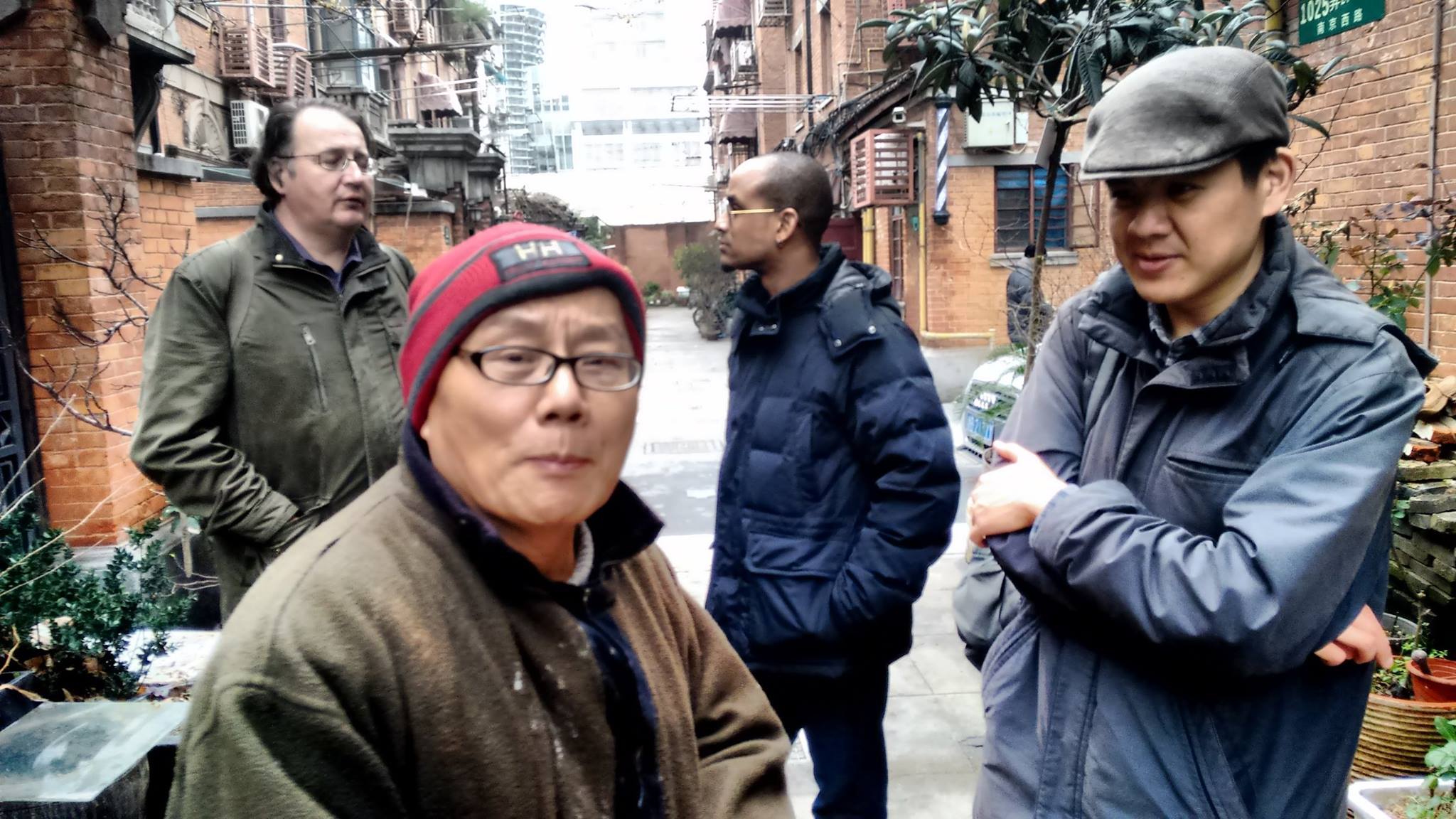
I want to begin this chapter at the kiosk because the kiosk is, in my best understanding of how Tranquil Light works, the most politically important square metre in the compound. Around it, every afternoon between three-thirty and six, fifteen to twenty residents stand or sit on a bamboo chair under a wide green umbrella. They drink tea from thermoses. They smoke. They read each other’s newspapers. They talk. The talk circulates through the compound and out into the surrounding district. It comes back two days later carrying corrections and additions and rumours. It is, on any given afternoon, the most reliable single source of information about who in Tranquil Light has been visited by the wuye, what relocation packages have been offered in the high-rise compound on East Yan’an Road, and which households are quietly considering whether to move.[1]
It took me longer than I would have liked to recognise what the kiosk was. For the first two months of fieldwork I treated it as background – a place where my informants told me to meet them, the way someone might say to meet at the coffee shop on the corner. The shorthand was so casual I did not at first hear it. Then I had a small intellectual moment, sitting at the bamboo chair on a hot September afternoon in 2013, when I realised that nearly every conversation I had been having about state-led displacement in Tranquil Light had originated, by some short chain of transmission, at this kiosk. The kiosk was not the background of the political life of the compound. The kiosk was the political life of the compound.
The physical facts of the place matter. Sandwiched between two rows of three-storey houses, the north-gate corner stays in shade for most of the day. When the sun softens, the voices rise. I learned to tell the hour by the volume. A dozen people around the umbrella at four o’clock sounded different from six people at half past two. The two lottery saleswomen who worked the kiosk on a rotating basis were themselves retirees on municipal pensions. ‘I don’t really make money at all selling lottery tickets,’ one of them told me early on. ‘The profit margin is almost nothing. But this job gives me something to do, and I enjoy meeting my old friends here.’ The commercial transaction was never grab-and-go. Printed tickets took two minutes. Scratch tickets could take ten, because buyers stayed to chat while they scratched. ‘Who would just scratch off the concealer and go?’ she said. ‘They’d chat with us while scratching it, and we would talk about all kinds of things.’ Gambling is formally restricted in China. The minor excitement of a lottery ticket was, for many of the afternoon regulars, a pretext for lingering. The lingering was the point.
The saleswomen were more than vendors. They were informal connectors, mediators, and gatekeepers. Old neighbours and new residents first approached them on a professional basis; once contact was established, the depth of the interaction grew. Because they knew nearly everyone who still lived in the compound and a large share of those who had left, they functioned as a living database. The neighbourhood committee and, on occasion, officers from the State Administration for Industry and Commerce sought information from them. Party Secretary Zhang visited regularly, though he did not buy tickets and did not linger. His relationship to the kiosk was extractive and professional. He spoke briefly to the saleswomen, took what he needed, and left. The residents understood the arrangement. The kiosk worked both ways: it fed the compound’s political competence, and it fed the local state’s capacity to count heads.[2]
I owed my own residency in Tranquil Light, in part, to those two saleswomen. After they registered me – unofficially, by name and basic circumstance – into their informal network, they asked around for a cheap room on my behalf. A week later one of them told me that an old neighbour who worked as an agent had a tenant thinking of leaving before her contract ended. The agent, unsurprisingly, was Teacher Hu. What surprised me was the efficiency. Teacher Hu himself had not known the tenant was considering leaving until the saleswomen told him. The kiosk had found the room, screened the budget, and connected the parties before either side had asked publicly. That is how the corner worked when the subject was housing. It worked the same way when the subject was demolition.
This chapter is about what kind of political life that turns out to be. It is also a chapter about displacement – about the specific repertoire of strategies the residents of Tranquil Light have developed, over twenty-five years of pressure, to remain in their homes. The two subjects are the same subject. The residents’ continued ability to live where they live is the product, daily and cumulatively, of the conversations at the kiosk.
Displacement, in a Useful Sense
The literature on Chinese urban displacement is now substantial. It tends, in my reading, to assume one of two pictures. The first picture treats the urban resident as a victim of state power: someone whose home is taken, whose options are foreclosed, whose grief is real. The second picture, sometimes published as a corrective to the first, treats the urban resident as a savvy bargainer: someone who knows the price of land, who plays the relocation game, who eventually walks away with a substantial cash settlement. Both pictures are partially true. Neither, by itself, is the picture that fits Tranquil Light.
Qin Shao’s Shanghai Gone has already shown, with documentary force, how forced eviction and eminent domain worked in Shanghai when residents lacked easy access to information and legal support.[3] Those accounts match what older residents told me about the 1990s. The more recent quantitative picture is more mixed. Systematic surveys of displaced families have found that many relocated households did not voice discontent once compensation and housing quality improved relative to earlier decades.[4] Neither the victim frame nor the bargainer frame, taken alone, explains why Tranquil Light is still standing, or why so many of its former residents keep returning to the north gate to talk.
The picture that fits Tranquil Light is more particular. It is a picture of collective political competence – of a community of residents who have, over twenty-five years, developed an extremely fine-grained, locally calibrated, daily-updated body of knowledge about how state-led redevelopment works in their district, and who have used that knowledge to remain, to gain bargaining leverage, and to extract better terms when bargaining is unavoidable. The competence is not heroic. It is workmanlike. It is also not natural to the residents in any deep cultural sense. They have learned it, slowly, in conversation with each other and with the small steady drip of nearby compounds being demolished.
I want to call the underlying social technology of this competence ‘corner society’ – borrowing, with care, from William Foote Whyte’s 1943 study of an Italian-American neighbourhood in Boston.[5] Whyte’s argument, simplified, was that what looked from the outside like the chaotic life of a slum was, on closer examination, a tightly organised social fabric whose organisational nodes were the corners – the literal urban corners where men gathered, where information was exchanged, where loyalties were tested, and where what we would now call governance was performed. Whyte was writing about a particular American immigrant neighbourhood in a particular decade, and his argument has been usefully complicated by every subsequent generation of urban anthropologists. The underlying intuition – that small, persistent, daily gatherings at fixed urban locations are the medium through which neighbourhood politics gets done – translates, with very few adjustments, to the corner of Tranquil Light’s first northern lane.
The kiosk is not the only such corner in Tranquil Light. There is also Teacher Hu’s shop, which I described in Chapter 2. There is the brick laundry wall on the west side of the thoroughfare. There is the bench by the south gate. There is the eighth-row landing where the older men play xiangqi. Each is a different kind of corner. Each has a slightly different demography. Each circulates a slightly different kind of information. Together they constitute the compound’s political infrastructure. The compound has no formal political organisation. It does not need one. It has the kiosk.
I have written, with my collaborator Matthew Williams, on the related subject of how lilong residents move and do not move within central Shanghai.[6] What I want to add in this chapter is the local-level mechanism by which that movement gets decided. The decisions are not, in any household I came to know in Tranquil Light, made by the household alone. They are made by the household after weeks of consultation at the kiosk and at Teacher Hu’s shop. The consultation is itself the chapter’s analytical object.
Package Intelligence
Chapter 1 sketched the two strategies the local government uses when it wants to clear a compound: the ‘all for one’ approach (yidaibao), in which a single package is offered to every household, and the divide-and-conquer approach, in which selected households are approached privately with more generous individual terms designed to crack the collective hold-out. I do not need to restate that typology here. What Chapter 1 could only flag, and what this chapter can show, is where the typology becomes operational knowledge.
It becomes operational at the kiosk.
On Tuesday and Thursday afternoons especially – the days when more old neighbours returned from the suburbs to visit parents still living in the lanes – the conversation around the umbrella turned, almost without fail, to packages. Someone had heard that a compound three blocks east had settled at a certain figure per square metre. Someone else corrected the figure. A third person named the household that had taken an individual deal and left early. The correction mattered more than the original rumour. The kiosk’s value was not that it produced news. Its value was that it refined news until the refined version could be used.
I watched this refinement repeatedly. An original resident would arrive with a scrap of information – a neighbour’s son had been approached by the wuye; a flyer had appeared on a gatepost elsewhere in the district; a relative in another lilong had been offered a flat in Minhang plus cash. The scrap would be tested against what the afternoon group already knew. Dates were checked. Names were checked. Whether the offer was collective or individual was checked first, because that distinction determined the political response. If the offer looked like yidaibao, the advice that circulated was hold together, compare notes, do not sign alone. If the offer looked like divide-and-conquer, the advice was different: identify who had been approached, make the approach public inside the compound before it could become private leverage, and raise the floor of any subsequent collective talk by naming the better individual terms already floated.[7]
The operating language was homely and precise. A near-variant of the same instruction circulated for months: someone had heard that households in the high-rise compound on East Yan’an Road were getting eight hundred yuan per square metre; the figure would be corrected; the group would decide that Tranquil Light should not accept less; sons and daughters would be told not to speak alone with the wuye if they came tomorrow. I heard that sequence, or something built from the same parts, dozens of times. What mattered was less any single number than the procedure: bring the scrap to the kiosk, let the afternoon group strip it down, leave with a floor price and a rule of silence toward official approaches. Hearing the procedure assembled in real time, from rumour to working instruction, was watching the compound govern itself without a meeting.
The lottery saleswomen were central to this circulation even when they said little. People brought news to them because they were always there. People trusted their memory of who had said what the previous week. People used their stall as a bulletin board without ever posting a notice. When Mr. Bo, the temporary neighbourhood-committee staffer known locally as Lazy Bo, needed to know who had moved in, he learned it through the kiosk within two days – often via Mr. Liang, my elderly corridor neighbour, who sometimes sat under the umbrella and carried news both directions. When residents needed to know who had been quietly sounded out about leaving, they learned it the same way. The state’s surveillance and the residents’ counter-surveillance shared a physical address.
Old neighbours who had already relocated were often the best sources on package design, because they had lived through earlier rounds elsewhere and because they still returned. At the north gate they compared notes about housing prices, what their own compounds had accepted, and which clauses in a relocation contract were decorative. Their talk was not always accurate. It was almost always useful. Accuracy, at the kiosk, was a collective product built across several afternoons, not a single reliable informant.
This is why the compound’s bargaining position, month to month, was never the product of a meeting. There was no association, no elected committee of hold-outs, no formal vote. There was an afternoon density of talk that made private approaches hard to keep private. The divide-and-conquer strategy depends on secrecy lasting long enough for the first acceptances to demoralise the rest. At Tranquil Light, secrecy rarely lasted that long. The kiosk shortened the half-life of a confidential offer. That shortening was political work, performed by people drinking tea.
Mrs. Hsu: The Returnee
I met Mrs. Hsu, who was fifty-one when we met, on a Tuesday afternoon in October 2013. She had walked into the compound from the north gate, looked around for a moment, and walked, with a directness I did not at first place, to the door of the third house on the second lane. She knocked. The current resident, a retired woman in her seventies whom I will call Mrs. Yang, opened the door. They had not seen each other in a long time. They embraced.[8]
Mrs. Hsu’s grandparents had, in 1933, bought the house Mrs. Yang now occupied. They had moved to Shanghai from Hong Kong during the city’s commercial peak, looking, in Mrs. Hsu’s later phrasing, ‘to be successful in business in the Paris of the Orient.’ They had been moderately successful. They had owned the entire three-storey house, then, and lived in it with their three children – one of whom was Mrs. Hsu’s mother – through the Sino-Japanese War, the civil war, and the early years of the People’s Republic. In the last months before 1949, many relatives fled to Hong Kong, Taiwan, and Southeast Asia. The grandparents stayed. They had recently put the bulk of their savings into the house. Mrs. Hsu later recalled her grandfather saying that uncertainty about relocating elsewhere, as much as attachment to Shanghai, kept them put. The house was nationalised after 1949. The government judged it too large for a six-member household and redistributed space to five other families. The Hsus were compressed, over the following decades, into a single room where three generations lived together. They were moved again to smaller quarters as their work unit saw fit, then eventually reallocated space back inside Tranquil Light. Mrs. Hsu was born, in 1962, in a portion of the house her grandparents had once owned outright. She had spent her early childhood in the room above what was now Mrs. Yang’s living room. The family later emigrated to Canada; Mrs. Hsu grew up in Vancouver, went to college in Toronto, and built a small import-export business there. She had returned to Shanghai, in the autumn of 2013, to consider whether she wanted to buy a room – perhaps the same room – back.
Teacher Hu, who knew nearly everyone still connected to the compound’s housing economy, had no idea who she was when she first appeared. That fact itself told me something. The kiosk’s archive was deeper than any single spokesman’s memory. Mrs. Hsu’s grandparents belonged to a layer of pre-1949 ownership that the post-reform rental economy had partly overwritten. The afternoon group at the north gate still held pieces of it.
It was not legally simple to buy back in. Mrs. Hsu had given up her Chinese citizenship at some point in the 1980s, which meant she could not, under the rules in force in 2013, purchase residential property in central Shanghai without a complicated set of waivers. She investigated the waivers; she would tell me, several months later, that the process was both possible and not worth her money. She abandoned the purchase. She did not abandon the visit. Over the next eighteen months she returned to Tranquil Light four times.
The first visit was the October afternoon with Mrs. Yang – the door, the embrace, the slow walk back toward the north gate afterwards. Mrs. Hsu did not yet sit long at the kiosk that day. She was still reading the compound as a private landscape. She pointed out, to no one in particular, where the lane had smelled of cooking in summer, where everyone had come outside to cool down because the rooms were unbearable, where you could hear every neighbour’s conversation whether you wanted to or not. Mrs. Yang filled in dates. Mrs. Hsu listened more than she spoke.
The second visit, a few months later in early 2014, was when the kiosk absorbed her. She arrived late morning, walked the thoroughfare, stopped at Teacher Hu’s shop long enough to be introduced properly, and then sat for the afternoon on the bamboo chair under the umbrella. ‘My entire memory of growing up in China,’ she told me that day, ‘is in and about this neighbourhood.’ The lottery saleswoman knew, by then, who she was. Several of the older residents had memories of Mrs. Hsu’s mother as a young woman in the 1950s. They corrected Mrs. Hsu’s account of her grandfather’s chemical-distribution business. They added details she had not heard – which lane the deliveries came down, which neighbour had worked for the firm, which portion of the house had been taken first after redistribution. The conversation, for Mrs. Hsu, was not nostalgic. The conversation was forensic. She was reconstructing, with the kiosk’s help, a family history that Vancouver had not been able to give her.
On the third visit, mid-2014, she spent more time at Mrs. Yang’s house than at the kiosk, but the kiosk still framed the day. She came out of the second lane carrying questions the afternoon group could answer: whether a particular tongxue of her mother’s was still alive; whether anyone remembered the family that had taken the ground-floor rooms in 1951; whether the Thursday lane-cleaning she half-remembered had really been as regular as her mother claimed. The answers were partial and overlapping. That was how the archive worked. No one person held the whole file. The group, over an afternoon, assembled usable pieces.
The fourth visit, late in 2014, was quieter. By then Mrs. Hsu had decided against purchasing. She still came. She still sat. She still corrected and was corrected. The purchase had been one reason to return. The compound’s memory had become another. ‘Shanghainese citizens are familiar with the process of displacement,’ she said on that visit, not as a complaint but as a diagnostic. Many of her classmates, she told me, had been relocated to the new villages (xincun) of the 1950s and after; contact with them had been hard to keep. She recognised, in the present pressure on Tranquil Light, a longer pattern she had lived through in an earlier register.
I want to flag a small theoretical observation about this. The kiosk’s information work is usually described, in this chapter, as politically functional – a system for circulating news about relocations and bargaining strategies. It is also, on the evidence of Mrs. Hsu’s four visits, archivally functional. The kiosk holds the compound’s collective memory. The memory is, in many cases, the only surviving record of what the compound’s pre-1949 history actually was. The Shanghai Municipal Archives have parts of it. The kiosk has the rest.[9]
Mrs. Hsu’s case also tells us something about the audience for the kiosk’s information work. The audience is not only the residents of the compound and the local state. The audience includes returnees: Shanghainese-born expatriates and their descendants who, for one reason or another, are considering coming back. The flow of these returnees through the kiosk in the years I was there was small but constant. They came from Vancouver, from Sydney, from London, from a particular suburb of Los Angeles. Each of them, like Mrs. Hsu, had a partial memory of the compound that the kiosk could complete. The kiosk’s value to the compound’s collective political position included the value of being a place returnees came to. Returnees, in turn, were potential investors, potential allies in preservation campaigns, potential public voices. The kiosk knew this. The kiosk treated returnees with care.
Auntie Yan
Auntie Yan – Yan A-Yi, the name she asked me to use – was not a returnee from overseas. She was a different kind of regular at the kiosk, and she belongs in this chapter because she shows how the corner organises people who have already left without having left completely.
She always stopped at the lottery stall before walking down the main lane toward the house she now occupied just outside the south gate. The two saleswomen were long-time friends of hers. Similar to Mrs. Hsu, Auntie Yan had once lived inside Tranquil Light. ‘It’s still vivid in my mind how we women in the neighbourhood – little girls, adults, and old women alike – had the task of cleaning the lanes every Thursday,’ she told me. After she gave birth to a daughter in the late 1970s, she and her husband decided the small room would not be enough for three. They asked the head of their work unit to help them find someone willing to trade spaces. Trading was then one of the few legitimate ways families could expand under the planned economy.[10] Tranquil Light’s location and prestige made the trade easy. Single comrades and childless couples wanted in. Auntie Yan wanted out, into more square metres.
She got the metres. She did not relinquish the compound as a social address. The kiosk was where she met old neighbours before walking with them to the street-office (jiedao) building for retiree activities – dancing, group singing, basic English classes run by local volunteers. Most of the old neighbours went ‘for fun’ (jiu shi lai wan yi wan). Auntie Yan was more determined. Her daughter was living abroad in an English-speaking country, and she wanted enough English to visit, perhaps eventually to live there. I shadowed her and her companions from the kiosk to the jiedao more than once. The planning of who would attend which class happened under the umbrella first. The classroom was downstream of the corner.
Auntie Yan’s pattern matters for the chapter’s argument. Departure from Tranquil Light is rarely a clean break. The people who leave continue to use the compound’s political infrastructure – sometimes for nostalgia, sometimes for practical coordination, sometimes, as with package talk, for intelligence that still affects relatives who remain. The kiosk is not only a tool for those who stay. It is a tool for those who left and still need the network the lanes produce.
Ms. Cheng: A Decade of Difficulty
Ms. Cheng was born, in the mid-1950s, in a hospital five blocks from Tranquil Light. Her parents had been allocated a room in the compound shortly after the founding of the People’s Republic, through the work-unit system. She lived in that room – a former master bedroom on the second floor of a different building from mine – for nearly forty years.[11]
When she married, in the mid-1980s, she faced a problem that nearly every newly married Shanghainese woman of her generation faced: where to live. The work-unit housing system was strained; new allocations were rare; the central city was already, by the standards of the time, considered crowded. Finding a new place was possible, but under the government-controlled system there was no guarantee it would be in the city, let alone in the upper quarter. Her parents, then in their early sixties, made an offer. They had managed, through their own pension scheme, to obtain a small unit in a newly built apartment block in one of the inner suburbs. They would move there. They would leave Tranquil Light to Ms. Cheng and her husband. The offer was unusual – it was Shanghai practice, in those decades, for the husband’s family to provide the marriage flat (hunfang) – but Ms. Cheng’s parents were determined. Ms. Cheng had a university degree from a well-regarded Shanghai institution and a steady accountant’s post at a respected work unit; her husband had not attended a prestigious college. The unusual uxorilocal arrangement followed from that imbalance more than from ideology. ‘We don’t have anything to do in the city anymore,’ her mother told her. ‘Take it.’
The arrangement worked, in the simple sense, for almost ten years. Ms. Cheng and her husband and, eventually, their son lived in the second-floor room. Until the boy was ten, the three of them slept in the same space. A neighbour who was Ms. Cheng’s confidant told me later that the lack of intimacy had been taking a toll on the marriage, and that Ms. Cheng talked about it ‘almost every day, and at almost every opportunity.’ Using money she had saved, Ms. Cheng bought a small pavilion room on the third floor of the same house from a retiring couple, for her son to have his own space. The three of them lived in that split arrangement for a few years. The arrangement worked less well in the deeper sense. Ms. Cheng’s husband had what she described carefully as ‘chronic infidelity issues.’ The marriage failed. Divorce, while legal, was still scandalous enough to feed lane gossip. Ms. Cheng’s son developed a learning condition that, in the local language of the lane, would have been described as autism, and was bullied by other children in the compound. The intersection of the divorce, the bullying, and the steady gossip – gossip that, for the first time in her adult life, was about her – became more than Ms. Cheng could absorb.
She made a decision that, by the standards of Tranquil Light, was unusual. She left.
She sold both rooms – the second-floor room she had inherited from her parents and the third-floor pavilion room she had bought for her son – to new tenants. She used the money, plus help from her parents, to buy a fifty-five-square-metre two-bedroom apartment in a southwestern suburb that, in the late 1990s and early 2000s, was considered to be in the middle of nowhere. The metro did not yet reach it. Shanghai’s metro then consisted of two lines; even Line 3’s later southward extension would not come near her building. She took two buses each way to keep her old work-unit job. The rides took roughly two hours in each direction. Her son was zoned to a substantially worse school unless she committed to a daily city commute to keep him in a better one. She chose the suburban school. The network of childhood friends, all of whom were still in the compound, was suddenly an hour and a half away by public transport.
I want to dwell on the next decade of Ms. Cheng’s life because it is, in microcosm, the chapter’s main argument about why people in Tranquil Light do not leave even when the room is small and the bathroom is shared.
The physical contrast was absolute. In the lilong, the staircase was shared by the whole building; the bathroom was shared by three families; the kitchen sat in the internal corridor and never felt fully hers – she had suspected for years, watching her gas bills rise, that neighbours used the stove when she was out. In the new high-rise, each floor held a few apartments with two bedrooms, a bathroom, a kitchen, and a living room. Privacy arrived. So did a different kind of silence.
For about ten years after she moved, by her own and several friends’ account, Ms. Cheng was unhappy. The unhappiness was not principally about her son’s school, although the school was worse. It was not principally about the commute, although the commute was demoralising – two buses, four hours on a workday before anything else was done. Winter mornings meant leaving in the dark. Summer evenings meant returning after the suburban shops had mostly closed. She described the bus rides to me without drama: standing room, wet coats, the particular fatigue of repeating the same transfer because the metro map had not yet drawn her neighbourhood into the city. The school decision sat on top of that fatigue. Keeping her son in a better city school would have meant a second daily commute layered on the first. She chose the local school and lived with the knowledge that the choice was a compromise she would not have faced in Tranquil Light.
The deeper unhappiness was about the social network she had left behind. The compound she had moved out of had been, in the workmanlike daily way I have been trying to describe, the medium through which she lived her life. The network of childhood friends – the women who would, on a Tuesday afternoon, gather at the laundry wall and trade news, who would have advised her through her divorce, who would have intervened with the school about her son – had not been replaced by any equivalent in the new suburb. The new suburb was a high-rise apartment complex. It had no laundry wall. It had no kiosk. The neighbours had moved in around the same time and were strangers to one another. You could live on the same floor for years and exchange only nods at the lift. Privacy, which she had needed after the gossip of the lanes, arrived as isolation. The high-rise gave her a door that closed. It did not give her a place where closing the door was optional because someone already knew when to knock.
Some neighbours in Tranquil Light thought she had made a mistake. ‘Why would anyone do that?’ one of her tongxue asked, in a line Ms. Cheng still quoted years later. This was the moment when Shanghai’s new economic regime was still uncertain to people who had lived through four decades of relative infrastructural stasis. Leaving the upper quarter for a far suburb looked, to many who stayed, like abandoning position. Ms. Cheng heard the judgement on her return visits and did not argue hard against it at the time. She was busy surviving the decade.
The story has, to some extent, a happy ending on paper. Ms. Cheng’s apartment, located in a part of Shanghai that was eventually chosen as the site for the 2010 World Expo, appreciated significantly in value. Metro lines, buses, elevated highways, malls, and hospitals followed. A neighbour in a similar building sold at roughly twenty times the purchase price. By the time I met her, in 2014, Ms. Cheng was wealthier on paper than nearly any of her former Tranquil Light neighbours. ‘The price doesn’t mean much to me personally,’ she told me. ‘It will mean something to my son when he wants to buy his own place.’ She was pragmatic about the next stage: she preferred her son nearby, but she had lived in a lilong where privacy did not exist, and she would rather buy herself a cheap place farther out than share a roof with a daughter-in-law under those conditions again.
She came back to Tranquil Light, when she could, three or four times a month. Her office was still close. Her childhood friends were still there. She came back, principally, to the kiosk. The afternoon group there had reabsorbed her, two decades after her departure, as if she had never left. ‘This is where I’m from,’ she said, on one of the afternoons we sat there together. ‘Everywhere else is just where I sleep.’ The Expo had made her suburb into a connected place. It had not given her a laundry wall. The distinction is the chapter’s point in miniature.[12]
Better a Bed in Puxi than a House in Pudong
There is a saying in Tranquil Light that I heard, with small variations, several dozen times over the course of fieldwork. It goes: ‘Ning yao Puxi yi zhang chuang, bu yao Pudong yi tao fang.’ Better a bed in Puxi than a house in Pudong.
Puxi is the older, denser, treaty-port-era half of central Shanghai west of the Huangpu River. It is where Tranquil Light is. Pudong, east of the river, is the newer, taller, financial district built almost entirely since the 1990s – the Shanghai of the postcards I described in the Introduction, with its three glass skyscrapers visible across the water. The saying is, on its face, a small irrational preference: a bed in a cramped lilong is preferred to a full apartment in a shiny new high-rise. The market obviously disagrees: the per-square-metre prices in central Pudong are now higher than the per-square-metre prices for most of Puxi’s surviving lilong stock, including Tranquil Light. The economic case for accepting a relocation package and moving across the river is not, in 2014, marginal. It is overwhelming.
And yet the saying holds. The saying holds for the same set of reasons Ms. Cheng’s decade in the suburbs was unhappy. A bed in Puxi comes with the kiosk and Teacher Hu’s shop and the laundry wall and the seventy-year-old social network that the compound has been quietly producing for three generations. A house in Pudong, however large and however well-furnished, comes without any of those things. The saying is not, on inspection, irrational. The saying is a reasonably accurate cost-benefit analysis carried out with reference to the cost categories that the residents most care about, which are not square metres but social ties.
Ms. Cheng introduced me to Mr. and Mrs. Zheng, who made the crossing early and lived the saying from the other side. Both had worked for a public bus work unit for four decades. They were relocated to Pudong in the early 1990s, before the east bank was urbanised in any sense that would impress a Shanghainese born west of the river. The landscape then was two-storey row houses and five-storey walk-ups in a Soviet-influenced style. Crossing required a slow boat. In the minds of native Shanghainese born before the 1990s, even Puxi’s lower quarter was already a comedown; Pudong was beyond the pale – long a hub for heavy industry, underdeveloped, inconvenient.[13]
When I met them in 2014, they laughed at the saying and then endorsed its 1990s version without hesitation. Nobody had wanted to move east then, they said, even though houses were much cheaper. There were no buses to speak of; the first metro line opened in 1993 and ran only on the Puxi side. They had liquidated what they had, borrowed from friends and relatives, and bought anyway, because their daughter was becoming a woman and they wanted to give her space. Each workday they biked an hour to the pier, loaded the bikes onto the boat, crossed, and biked another hour to the work unit. People thought they were a nao bing couple – brain-damaged, in the affectionate cruelty of lane speech.
By 2014 the arithmetic had flipped on paper. They held two four-bedroom duplex apartments near Century Park, within walking distance of a metro station, schools, and large markets. Their daughter had completed a master’s degree in the United States and was working there. Mr. and Mrs. Zheng travelled abroad most months. They rented out portions of both units – preferring foreign tenants, they said, because foreigners paid on time, cooked less, and did not quietly multiply the occupancy. Their monthly rental income sat well above a fresh graduate’s salary in Shanghai, on top of their pensions. They were planning further purchases in Minhang and Zhabei. By every market measure, they had won.
They still returned to Tranquil Light mainly on ‘special days,’ when they wanted the dumplings and pastries (dian xin) that only the restaurant around the compound’s corner did well. The visits were culinary and social, not residential. Their life was in Pudong. Their taste memory was still in Puxi. Younger Shanghainese I knew – Ai, for instance, who had grown up in the 1980s and 1990s – could acknowledge Lujiazui’s global status and still refuse the crossing: ‘Pudong is always Pudong.’ The saying survives the skyline.
I want something stronger than local colour from this. The Puxi-bed-Pudong-house saying is, in its small way, a piece of vernacular political theory. It articulates, more cleanly than most academic literature on Chinese urban displacement does, what the residents of Tranquil Light are actually defending when they refuse to relocate. They are not defending the building, although they are willing to perform an attachment to the building when performing one helps. They are not defending some abstract preservationist principle. They are defending the social network the building hosts. The building is the network’s substrate. Demolish the building, the network goes too. Relocate the network’s members to four different suburban high-rises in four different districts, the network is gone forever.
The local government understands this less well than the residents do. Relocation packages are calculated, in nearly every case, in square metres and yuan. Compensation for the displacement of social networks is not, formally, a category. The residents have learned to translate, when negotiating, between their own valuation of what they are losing and the state’s valuation of what it is offering. The translation is rough. The residents typically come out of negotiations less unhappy than they would have been if they had taken the offer on its face. They also typically come out, on the social-network side, having lost things they cannot replace. Ms. Cheng’s paper wealth and the Zhengs’ duplexes do not contradict that loss. They illustrate how the market can repay square metres while leaving the laundry wall unpaid.
This is the chapter’s underlying claim about displacement. Displacement in central Shanghai in 2014 is not principally a story of homes being taken. Homes can be taken. Homes can be replaced, often with bigger and better-appointed homes. What cannot be replaced – what has not been replaced in the high-rise compounds the displaced residents are sent to – is the daily slow accumulation of acquaintance, obligation, gossip, history, and competence that, in a place like Tranquil Light, takes seventy years to build and that, once dispersed, does not come back. The residents who continue to live in Tranquil Light know this. The kiosk knows this. The state has been slower to learn it. The chapter is an account of what the residents have done, while the state was learning, to remain.
Conclusion
I have been writing in this chapter as though the residents of Tranquil Light have, collectively, won a small battle against the state – and as though the kiosk and Teacher Hu’s shop and the laundry wall are the political infrastructure that has allowed them to win it. This is partly true. It is also conditional.
The residents have won, so far, by being more politically alert than any single attempt to demolish their compound has been able to overcome. Each negotiation has produced, on balance, a better outcome for them than the previous one did. Each negotiation has also extracted something. The compound is smaller, demographically, than it was twenty years ago. The Wednesday cleaning Mrs. Liu described in Chapter 1 has not been replaced. The kiosk is still there, but the afternoon group around it is smaller and older than it was when I began visiting in 2011. Old neighbours like Auntie Yan and Ms. Cheng keep the density up on certain afternoons; they cannot stop the underlying ageing. The political infrastructure depends on the residents who maintain it. The residents who maintain it are ageing. The next decade will, I expect, be harder than the last one.[14]
The chapter that follows takes a different angle on the same set of pressures. Where this chapter has examined how residents resist displacement, the next examines how the same compound has been changing from the inside through a process I will call, after my 2016 article on the subject, middleclassification – a particular kind of self-driven gentrification in which the original residents are themselves the agents of class reshuffling.[15] Teacher Hu, as I will show there, learned the Mandarin term zhongchanjiejihua from planning students who interviewed him and then recirculated it through the same conversational circuits this chapter has been describing. The two chapters are, in their underlying politics, the same chapter. They describe what happens when residents are not passive in the face of urban change – whether the change arrives as a demolition threat from outside, or as a rental calculation made at the kiosk.