This chapter introduces Tranquil Light, the eight-decade-old lilong neighbourhood at the centre of Shanghai's commercial district that serves as the ethnographic spine of a book on globalisation, the heritage industry, and the economy of urban space. It situates the compound geographically – in the so-called upper quarter (shangzhijiao) of Shanghai, the densest concentration of treaty-port architecture and the most aggressively redeveloped part of the contemporary city – and historically, with a short sketch of how British speculative builders adapted the terraced rowhouse for Chinese labourers in the 1840s, and how the lilong came to dominate Shanghai's housing stock by the 1930s. It then describes the compound's physical and social architecture – the central thoroughfare alley, the 198 houses, the demographic split between long-term old residents and recent renters – and examines the political strategies residents use to manage state-led redevelopment pressure. The chapter closes with the cultural production of the ‘real Shanghai' through reconstructed neighbourhoods like Xintiandi and Tianzifang, arguing that what residents call authentic is, more precisely, what the city has agreed to be evaluated by.
You can walk past Tranquil Light without seeing it. I have done it many times, in the early years before I lived there. The compound sits on one of Shanghai's noisiest commercial streets, behind a steel gate set into a long brick wall, and the gate is set back just far enough from the curb that the wall reads as another building rather than as the entrance to a hundred and ninety-eight houses. Pedestrians walk past it. Tourists walk past it. Most of the office workers in the high-rises behind it have never been inside.[1]
Then, every few minutes, an old woman in pajamas comes through the gate.
She is on her way to the market. She moves slowly, hugging the wall on her left, because the sidewalk is full of office workers in a hurry, and a woman in her early seventies with a small bag and a green cart does not enter the river of office workers – she walks beside it, the way pedestrians used to walk beside trams. She crosses the side street at her own pace, ignores a delivery scooter that brakes hard for her, and disappears around the corner of a bank tower towards the wet market that is, for now, still tucked behind a parking garage two blocks east. Behind her, three more residents of Tranquil Light come through the gate. One is in pajamas. One is in what looks like a 1980s tracksuit. One is in a winter coat, although it is May.
If you stand across the street and look through the iron bars of the rebuilt gate, this is what you see. The slowest scene in central Shanghai, framed by the most expensive sidewalk in central Shanghai. A neighbourhood eight decades old, set inside a city that, on most days, would prefer it not to be.
The most obvious question to ask, standing there, is the economic one. How does this exist? The land Tranquil Light occupies, by 2014, was worth more per square metre than land in some parts of Mayfair. Its hundred and ninety-eight houses average less than a hundred square metres each, and most of them have been subdivided since 1949 to hold three to five families. The arithmetic is brutal. By every rule that has governed Chinese urban redevelopment since the early nineties, this compound should have been demolished and replaced with three high-rises eighteen years ago. By every rule that governs the global real estate market, the compound that survived demolition should now be inhabited by people who can afford it. And yet here is an old woman in pajamas, walking through its gate at half past nine on a Tuesday, on her way to a wet market that the city has been quietly trying to close for the last six years.[2]
The simplest answer is that the local government has, in spite of itself, learned how to preserve. There are plenty of places in Shanghai where this answer is at least partially true. The Bund. The old Jewish quarter. A handful of carefully labeled corners of the former French Concession. But the simpler answer falls apart the second you walk through the gate of Tranquil Light. The houses inside are not, by any technical standard of preservation, in the condition they are supposed to be in. The roofs leak. The bathrooms are shared. The kitchens have been built into what used to be courtyards. The interior walls have been moved at least twice in the lifetime of every resident I came to know. The compound has been preserved on the outside and modified on the inside, and the modification is not the kind of careful, period-faithful retrofit that preservation manuals describe. It is the modification of people who needed more storage and built it.[3]
The other simple answer is that Tranquil Light has been gentrified – taken over by the kinds of high-income residents who can pay enough to keep the building standing. There are projects like that elsewhere in Shanghai. Tranquil Light is not one of them. Two-thirds of its residents are over sixty, retired, on small pensions, and have lived in the same room since the danwei system gave it to them in the seventies or eighties. They are not the gentrifiers. If anything, they are the landlords of the gentrifiers, in a small sense, because they rent out their back rooms to the younger people who come to live in a ‘real' lilong. They are the working-class survivors of a series of policy decisions that were not, in their lifetimes, made with their interests in mind.
So the existence of Tranquil Light is not explained by either preservation or gentrification. It is explained by a third thing, which is what this chapter – and the book – is about. Tranquil Light exists because, over the past two decades, the residents of the compound have figured out – by trial and error, by talking to each other in the lanes – how to make the city's three competing logics work against one another. The logic of preservation, the logic of redevelopment, and the logic of gentrification, played one off against the next, leave a small gap. The residents have learned to live in that gap. They have learned to be photogenic when photogenic helps them, and invisible when invisible helps them. They have learned to make rent off the global tourist economy without losing their houses to it. They have learned, with what I came to recognise as remarkable political sophistication, how to position themselves as objects of state care so that they cannot easily be evicted, while quietly building extra kitchens in their courtyards. The chapter that follows is the picture, at a particular moment between 2013 and 2016, of how that arrangement looked from the inside.[4]
The book the chapter belongs to has a longer name. Locating Shanghai: Globalisation, Heritage Industry, and the Economy of Urban Space. The three nouns in the subtitle – globalisation, heritage industry, economy of urban space – are not separate topics. They are the same topic seen from three angles. Globalisation is what the city is performing. The heritage industry is the script of the performance. The economy of urban space is who pays, who is paid, who is moved, and who is allowed to stay. Tranquil Light sits at the intersection. It has been globalised, heritagised, and economised – sometimes by the state, sometimes by the market, sometimes by the residents themselves – and what makes it interesting, sociologically, is that the residents are not only objects of those three processes. They are, increasingly, agents of them.
The chapter has five tasks. It puts Tranquil Light on the map. It traces, in a short historical sketch, how the lilong as a building form came to dominate Shanghai. It describes the compound's physical and social architecture in some detail, because that architecture is the chapter's only real character until later chapters bring in the human ones. It examines the politics of urban space – particularly the long-running argument in Shanghai between the so-called upper quarter and the lower quarter, and how Tranquil Light came to sit, awkwardly, in the upper. And it ends in the place where every conversation about lilong eventually ends: two former lilong neighbourhoods that the local Shanghainese will tell you, with a straight face, are the ‘real Shanghai,' even though one of them was designed by an American architect inspired by villages in Tuscany.
A Hundred Yards from the Bund
The friend who first introduced me to Tranquil Light, a Shanghai-born colleague I met in 2011, used to make a joke about the compound that he had clearly made before. He would gesture at the gate, lower his voice, and say, in something close to a stage whisper:
‘Shanghai is the centre of China. China is the centre of the world. Tranquil Light is at the centre of Shanghai. Therefore.' Pause. ‘Therefore Tranquil Light is the centre of the world.'
Then he would laugh, and his friends would laugh, and the joke would be on the tip of his tongue again the next time we walked past the gate. The joke worked because nobody quite believed it and nobody quite disbelieved it either. Standing on the busiest sidewalk in central Shanghai, with a hundred years of British architectural inheritance behind you and a hundred billion dollars of contemporary Chinese capital in front of you, ‘the centre of the world' is not a sentence you can fully reject. It is also not a sentence you would publish.[5]
This chapter takes the joke seriously enough to use it as the title. I do this because, despite the joke, despite the wink, despite the obvious provincial pride that animated the line every time my friend used it, there is a sense in which the small arithmetic of Tranquil Light reproduces, at the scale of one neighbourhood, several of the larger arithmetics of contemporary global cities. Where else does eighty-year-old social housing share a wall with a ten-thousand-yuan-per-square-metre retail district? Where else does the working class of one decade rent the back rooms of its own former housing to the working class of the next? Where else does a city's central preservation district consist not of a national monument but of a hundred and ninety-eight working-class rowhouses built for a different kind of empire entirely? The ‘centre of the world' joke gestures, accidentally, at a real intuition. Tranquil Light is unusual. It is not unique. But its unusualness does interesting work, in a compressed form, in helping us see what cities do to old buildings when those old buildings continue to be lived in.
Tranquil Light occupies a single rectangular block on the south side of one of Shanghai's east-west commercial arteries. To the south, across a small side street, is a luxury hotel. To the east, the side wall of a high-rise office tower whose ground floor holds two coffee chains and a Swiss bank. To the west, the back loading dock of a department store that sells nothing under three thousand yuan. To the north, where the long thoroughfare alley of Tranquil Light empties out, is a smaller residential street, a primary school, and beyond the school the elevated highway that, for most of the twentieth century, marked the border between the French Concession and the International Settlement.
The block belongs to what Shanghainese, even in 2013, would still casually call the ‘upper quarter' (shangzhijiao) of the city. I will return to that phrase later in this chapter and again in the next; for now it is enough to know that the term is partly geographic, partly historical, and partly snobbish. The upper quarter is the part of central Shanghai that was developed first by the British, then by the French and the Americans, in the eight or nine decades between the city's forced opening to foreign trade in 1842 and the founding of the People's Republic of China in 1949. The lower quarter (xiazhijiao) is, broadly, everything else. Older Shanghainese still treat the distinction as morally meaningful. Younger ones, asked about it, will tell you that it is a relic, while continuing to live as if it were not.[6]
Tranquil Light, in other words, is in the part of Shanghai where the city's foreign past is densest, the part most heavily marked by the architecture of treaty-port commerce, and – by no coincidence – the part most aggressively redeveloped in the twenty-five years since the economic reforms reached the central districts. It is also, by no coincidence, the part where the surviving lilong are concentrated. To explain why those three things – densest foreign past, most aggressive redevelopment, surviving lilong – sit together in the same square mile is to explain how Tranquil Light came to exist at all. And to explain that, we have to back up almost two centuries.
How a British Form Became a Chinese City
By the middle of the nineteenth century, Shanghai had become the most convenient point of entry into China for foreign traders defeated, briefly, by their own success. The Opium Wars had ended with a series of treaties forcing the Qing Empire to cede sovereignty over a handful of coastal port cities to British, French, and American extraterritorial administration. Shanghai was the largest of those concessions. Within a decade of the treaty signing in 1842, what had been a medium-sized walled market town at the mouth of the Yangtze River began to swell – first with foreign capital, then with foreign labourers, then with the much larger flood of Chinese labourers needed to do the work the foreign labourers did not want to do.[7]
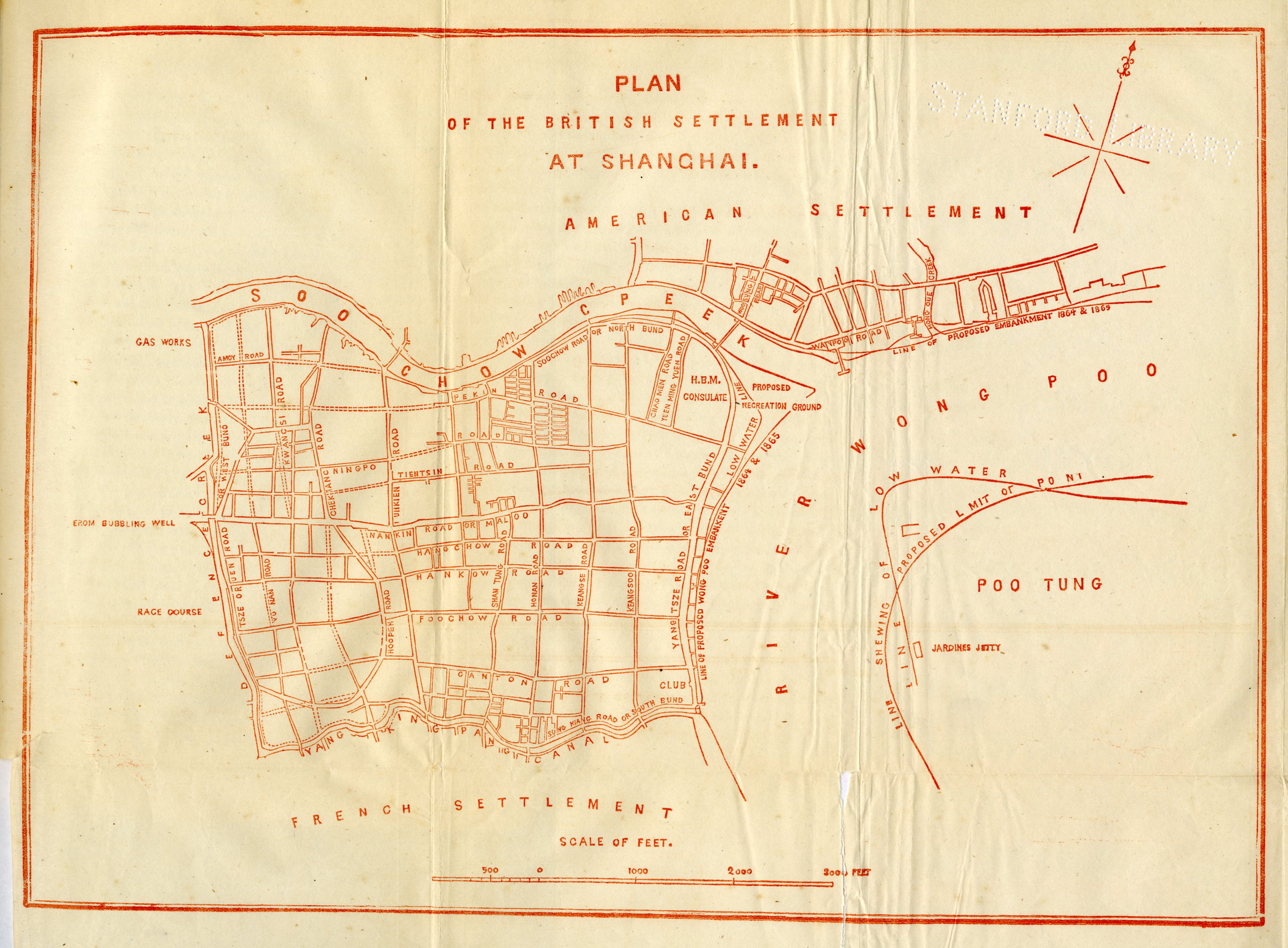
The British, who arrived first, brought their planning instincts with them. They imposed a rectangular grid on the flat geography of the delta. They built the gaslights and trams and paved roads that would, within a generation, mark Shanghai's skyline as visibly modern. And they faced – as the city's commerce blossomed – the same housing problem that British cities had faced fifty years earlier. Where do the workers live? How do you build housing for them quickly and cheaply, in a way that fits the new urban grid?
Their answer was a hybrid. They took the British terraced rowhouse – the long, narrow, common-walled form that had been built across the industrial Midlands for half a century – and they fitted it into the rectangular concession blocks. They wrapped each block in a perimeter of slightly larger commercial units fronting the street, and they tucked the rowhouses behind those, organised along narrow internal lanes accessed through gated openings. The result was a closed compound with shops on the outside, houses on the inside, and a single internal alley network connecting everything. The Chinese word for the gate-and-lane arrangement was lilong; the houses themselves came to be called shikumen, after the stone-framed doors that fronted the lanes.[8]
Two things distinguished the Shanghai version of the British rowhouse from its English original. First, the houses faced south rather than facing each other across a shared lane – an adaptation to the local insistence on solar exposure that, in turn, blurred the British distinction between front and back. The ‘front' of a Shanghai lilong house faced light; the ‘back' faced the rear of the next row. Cooking, washing, and the conduct of women's daily work moved into the lane. The lane became the social spine of the compound. Second, the original Shanghai lilong included a small front courtyard, between the south-facing entrance and the lane. This courtyard, considered a luxury even at the time of building, was minimised in later, denser developments and was almost always the first part of the house to be enclosed once the houses began to be subdivided in the twentieth century.
By the 1930s – the period of the city's commercial peak, the so-called Paris of the East period, the decades that produced Shanghai Bund and most of the popular memory the world has of Republican-era Shanghai – there were more than two hundred thousand lilong houses in the city, and roughly three million people lived in them. Lilong was not one option among many. Lilong was the form most Shanghainese lived in. To say ‘I live in Shanghai' was, for most working-class and middle-class Chinese residents in those decades, to say ‘I live in a lilong.'[9]
After 1949, the new Communist government nationalised the city's private housing stock. Most of the wealthy original owners, many of whom had been close to the losing Nationalist Party, fled Shanghai for Hong Kong, Taiwan, or the West. The houses they left behind were redistributed by work units (danwei) to the workers those units employed. Where one family had lived in a house, three or four families would now live. Walls were built across what had been parlours. Cooking pots moved into corridors. The lilong stopped being the housing of a particular class and started being the housing of nearly everyone the danwei had to house. No new lilong were built after 1949 – the Party found the form aesthetically suspect, ideologically tainted by its association with foreign capital, and structurally inefficient compared to the Soviet-inspired six-storey walkups they preferred.[10]
Then, beginning in the early 1980s, came the second great erasure. As the economic reforms of the Deng era reached central Shanghai, the lilong became, almost overnight, a problem. The two hundred thousand units that had been built for three million residents now, after subdivision, housed close to eleven million. The buildings were tired. The bathrooms had not been upgraded since before the war. The land they occupied was, suddenly, more valuable for high-rise apartments than for low-rise rowhouses. Between 1985 and 2010, by the most reliable available planning estimates, between two-thirds and three-quarters of all surviving lilong in central Shanghai were demolished.[11] Most were replaced by walkups in the inner city, by high-rise apartment blocks farther out, or by the commercial towers that now dominate the skyline of the upper quarter.
The remaining lilong – fewer than a hundred compounds by the time of my fieldwork – survived for one of three reasons. They had been formally listed for protection. They were close enough to a foreign-built monument that was already protected. Or they had been, by some local political accident, simply skipped. Tranquil Light was protected for the first reason. Its protection – granted in 2004, when the local government extended its preservation list from individual buildings to entire conservation districts – is the only reason the compound was still standing on the day I moved into my pavilion room.[12]
The historian Lu Hanchao has argued that the lilong is not, in any honest sense, a piece of Chinese architectural inheritance.[13] It is a foreign form that the Chinese learned to live in and, in the learning, made their own. That is closer to the truth than most municipal preservation language is willing to admit. The lilong is the housing the British built for Chinese labourers, then forgot about, then watched the Chinese labourers turn into a hundred-year ethnographic record of how a working-class population could live inside a building it did not design.
Inside the Gate
Inside the gate, what you see first is the alley.
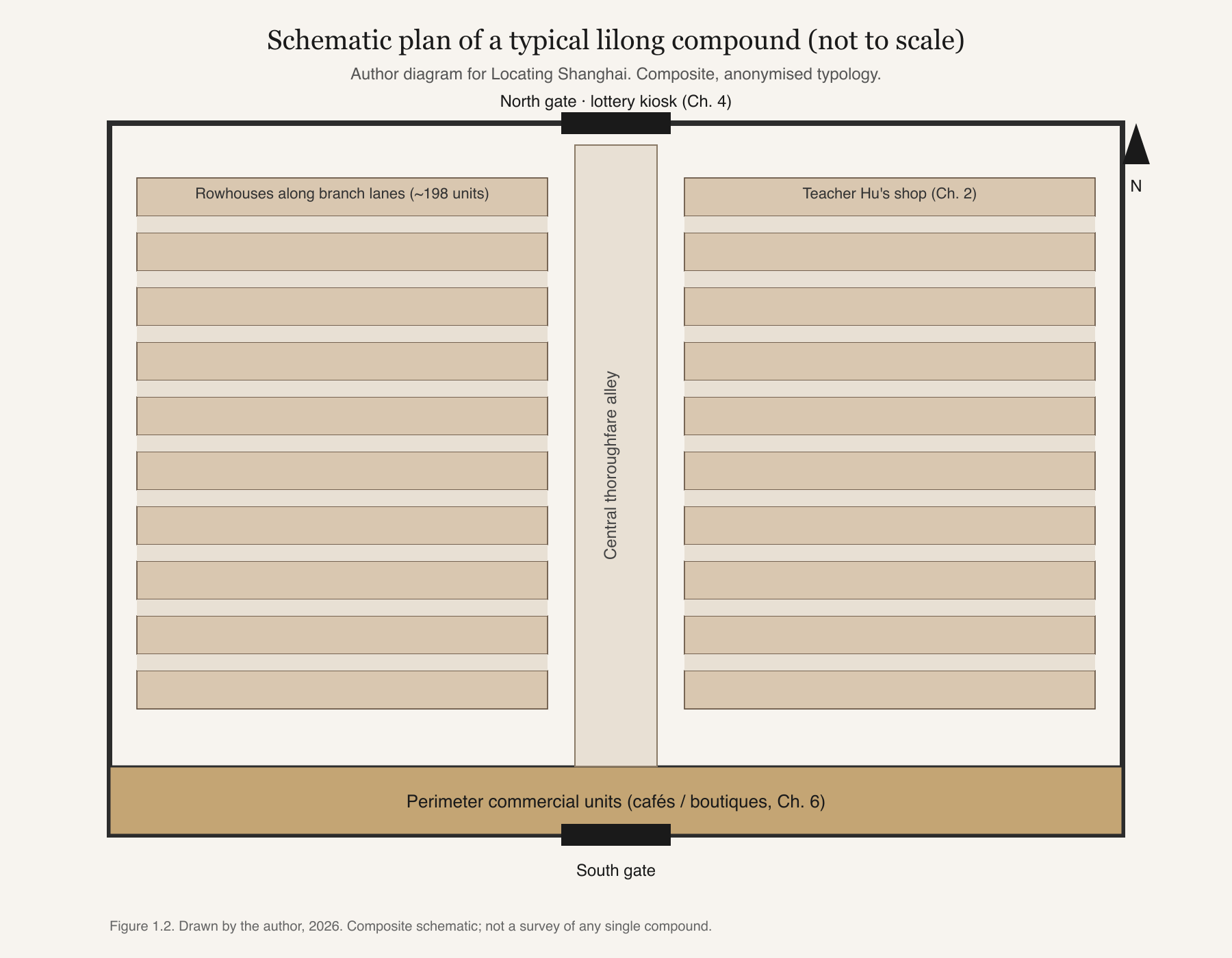
Tranquil Light's main thoroughfare runs north-south across the compound, roughly the length of two football fields end to end, seven metres across. From this central spine, eleven smaller branch lanes peel off east and west, each five metres wide, each leading to a row of about eighteen attached houses. There are, depending on how you count the corner units, a hundred and ninety-eight houses in total. There are also twenty mixed-use commercial units lining the perimeter wall on the south side of the compound, where the gate opens onto the busy street; these are mostly closed by 2013, their old shopfronts shuttered or converted into offices for the wuye, the property management company.[14]
Each house was originally built as a single-family three-storey rowhouse, designed for a household of two to three residents. By the time I arrived in 2013, each house was registered with the neighbourhood committee as a shared dwelling for an average of five households. Some held more. Some held fewer. The Hong Book of 1932 – a directory and address-finding volume published by the Foreign Commercial Press for the city's mostly foreign upper-middle-class – listed Tranquil Light's population at completion as roughly five hundred. By 1949, after nationalisation, that figure had grown to about fourteen hundred. By 2013 it was 3,172. About fourteen percent of those residents – 438, including me – were registered ‘non-locals,' meaning that we had been formally registered with the neighbourhood committee but did not hold Shanghainese hukou.[15]
The compound's history before its construction in the early 1930s is a small archaeology of treaty-port land use. According to an informant whose grandparents bought a house in 1932, the site had originally been a burial ground for a clan that had emigrated to Shanghai from the Pearl River Delta in the early nineteenth century. In the late nineteenth century, after the British took possession of the surrounding land, the cleared plot had been used as a horse stable, serving a racetrack that operated nearby until the 1940s. In the early 1920s, a Chinese tycoon from a neighbouring province bought the stable and built the compound that would, over the next two decades, house heads of foreign companies, high-profile politicians, two film directors, several physicians, and a handful of educators. After 1949, those original residents either fled or had their property confiscated, and the danwei system moved working-class residents in.[16]
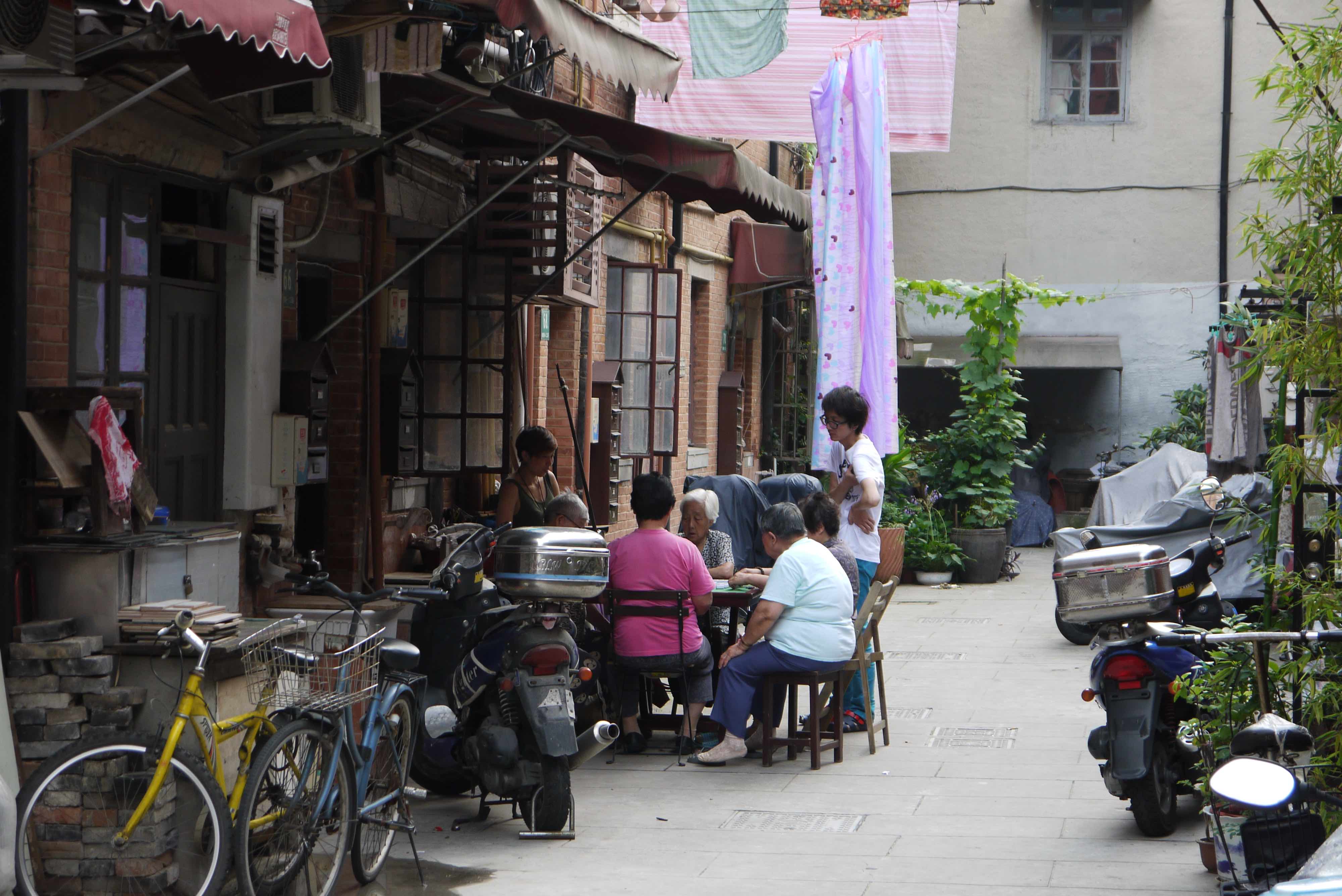
The two-thirds of current residents who count as ‘old residents' – people who moved in during the first decade of the PRC, or who later traded rooms with each other under the partial reforms of the seventies and eighties – make up most of what you see in the alleys during the daytime. They are retirees, mostly. They walk back and forth in the thoroughfare in the morning for exercise. They water their plants in the lane. They wash and hang laundry. They cook on small open-air stoves they have installed near the doors. The remaining one-third are renters: students, young professionals, foreign visitors, migrants from Anhui and Sichuan and Henan, and – though they are rarer – younger Shanghainese households trying to be cheaper to their parents than their parents would prefer.
I rented a small ‘pavilion room' (tingzijian) on the second-floor stair landing of one of the houses, directly above one of the entry gates, for 1,200 yuan a month, which was about two hundred U.S. dollars at the time. Most people I told about this thought I had won a lottery. A 33-year-old colleague at a local university, herself raised in a similar compound in the 1980s, told me, ‘Wow, you are so rich. I thought you were just a student.'[17]
Both of us were correct, in a way. The rent was, by Manhattan or central London standards, almost free. The room was, by almost any other standard, a shoebox: roughly four metres by two metres, with a single small north-facing window and no private kitchen or bathroom. I shared the kitchen with two other households on the floor below. I shared the bathroom with five. The corridor had no heating in winter and no ventilation in summer; from October to March I slept under three blankets, and from May to September I slept on the floor.
Pavilion rooms have a particular history in Shanghai literature. Originally designed as in-between spaces – neither service nor living – they were tucked above the rear stair landing where the lower ceiling height of the back service rooms left a small awkward volume. Residents used them for storage or as guest bedrooms. Later, as the housing market overheated in the early twentieth century, landlords began renting them out for extra income. Their northern exposure made them cold in winter and hot in summer, and their lack of plumbing made them suitable mostly for the poorest tenants – a category that, by the 1920s, included a great many Chinese writers and teachers. Lu Xun wrote in a pavilion room. Mao Dun wrote in a pavilion room. By the time I rented mine, in 2013, the pavilion rooms of Shanghai had become a literary trope; almost every Shanghai novel of a certain period contains one. From my own pavilion room window I had a clear view onto the gate, the thoroughfare, and the slow daily traffic of the residents I will introduce in the rest of this book.[18]
Upper Quarter, Lower Quarter
The pressure to demolish Tranquil Light has been constant since the 1990s. It has not been continuous, and it has not always been coordinated, and it has occasionally been answered by counter-pressures that have kept the compound standing. But the pressure has never gone away.
The land Tranquil Light sits on, by 2014, was assessed at a market value that would have made a high-rise commercial replacement enormously profitable for any developer who could clear the residents off it. The state-owned developer that holds the land use rights for the surrounding district has, over the years I have been visiting Shanghai, made several formal attempts and probably many more informal attempts to negotiate a clearance. None of those attempts has succeeded. The reasons they have not succeeded say something useful about how political work gets done at the alley level in twenty-first-century Chinese cities, and so I want to spend a moment on the strategies the residents of Tranquil Light have learned to use against the pressure.
There are, broadly, two strategies the local government has at its disposal when it wants to clear a residential compound for redevelopment. The first is what residents call the ‘all for one' approach (yidaibao). The government negotiates with the entire compound at once, sets a single relocation package, and offers the same terms to every household. This is the strategy residents prefer, because it makes collective bargaining easier. If everyone holds out, everyone gets the same deal, and the deal is usually not bad.
The second strategy is the divide-and-conquer one. The government's agents approach a small number of households privately, offer those households a more generous individual package than the collective one, and rely on those households' eventual public satisfaction – a satisfaction that travels by word of mouth – to crack the collective hold-out. Once a few residents accept generous terms, the rest learn that some neighbours got a better deal, the bargaining position breaks down, and individual households start cutting their own deals to avoid being left last.[19]
The residents of Tranquil Light have been preparing for both strategies for fifteen years. They know which one is being used, almost always, before the local government realizes it has chosen one. They know who in the compound has been approached and what was offered. They know, household by household, the value of the land per square metre at every recent comparable transaction in the surrounding three blocks. They know, in extraordinary detail, what the relocation packages have been at every nearby compound that has been cleared in the last decade. Most of them know more about Shanghai property law than the average junior bureaucrat does.
This knowledge does not arrive by accident. It is exchanged, daily, in the small public spaces of the compound: the brick laundry wall on the west side of the thoroughfare where everyone hangs sheets on Tuesdays; the corner shop that sells the lottery; the bench by the main gate where the morning regulars sit and read the newspaper; the south landing of the eighth row, where the older men play xiangqi every afternoon. I will return to those spaces in Chapter Four, where I treat the alley itself as the medium of the residents' political life. For now I want to note simply that those spaces are political. They are where information about the compound's threats is circulated and tested. They are where the residents collectively decide, without ever holding a formal meeting, what the compound's bargaining position is going to be this month.
There is a particular kind of statement that the older residents make when this circulation is working well. It goes something like this: ‘I heard from old Wang that the people in the high-rise compound on East Yan'an Road are getting eight hundred per square metre for relocation. We should not accept less than nine hundred. Tell your son not to talk to the wuye people if they come tomorrow.' That sentence, or some near variant of it, was said to me dozens of times over the course of my fieldwork. It is the operating language of the compound's political life.[20]
It is also, despite its homely texture, more politically sophisticated than most academic accounts of Chinese urban resident behaviour would predict. The picture of the urban Chinese resident as a passive subject of state power – a picture I had brought with me from much of the literature when I arrived – was the first picture my fieldwork dismantled.[21] The reason it dismantled, I came to believe, is that the residents of Tranquil Light have a structural advantage that residents in the surrounding high-rise compounds do not. They live in heritage. The local government, having spent the better part of two decades classifying and protecting the compound's façade, cannot easily order a wholesale demolition without invoking a public preservation embarrassment. What looks from the outside like state-led preservation is, from the inside, a particular configuration of the economy of urban space – one in which the residents have learned, slowly and collectively, to read the contradictions of the system better than the system can read itself.
The residents know this. They use it. They have, over the past decade, developed an instinct for which kinds of disturbance count as ‘spoiling the heritage' – a phrase the wuye uses constantly – and which kinds of disturbance the wuye is structurally compelled to tolerate. The residents are very careful to commit only the second kind. They build extra bedrooms inside their courtyards but never on their roofs. They install satellite dishes on the side of the house facing away from the street. They rent out their back rooms but not their front parlours. They keep the curtain over the bathroom door. They are, in short, precisely as visible as the heritage requires them to be and exactly as invisible as their interests demand.
The Real Shanghai Is Down the Street
I was given, in my first weeks of living in Tranquil Light, a piece of advice that I would receive again and again over the next sixteen months. It came from a senior resident named Mr. Zhang, who had been one of my first informants in 2011, and who had a habit of treating his own neighbourhood as if it were not quite worth my time.
‘You should go to Xintiandi,' Mr. Zhang said. ‘If you want to see the real Shanghai, you have to go there.'
Xintiandi is a former lilong neighbourhood about two kilometers south of Tranquil Light. In the early 2000s it was rebuilt – almost entirely from the ground up – by a Hong Kong–based developer and an American architect named Benjamin Wood. The result was a high-end retail and dining district designed to look like an old Shanghai lilong. The bricks are new bricks. The mortar is new mortar. The shopfronts house Cartier and Starbucks and a small army of bars and restaurants priced for an upper-middle-class consumer. A handful of original architectural elements were preserved from the structures that previously stood on the site, but most of what is there is reproduction.[22]
Tianzifang, the second neighbourhood Mr. Zhang would tell me to visit, is a different story but a similar effect. Tianzifang was a working lilong neighbourhood whose ground-floor units were converted, beginning in the late 1990s, into small art galleries, design boutiques, and tea rooms. By the late 2000s it had become one of the city's most heavily trafficked tourist destinations. By the mid-2010s, the residents who had once lived above the shops had largely sold or rented out their units; the neighbourhood was, by that point, a working tourist destination dressed in the architectural costume of a working residential block.
These were the two neighbourhoods, in other words, that nearly every Shanghai-born informant I met would direct me to as the ‘real Shanghai.' Both of them are reconstructions. One is almost entirely new construction. The other is old construction that has been substantially repurposed for visitors. Neither of them is primarily occupied by the kind of resident – older, working-class, here since the seventies – that occupies Tranquil Light, where I was actually living.
I want to take a moment with this puzzle, because it is not just a piece of misdirection. The reason my Shanghainese friends sent me to Xintiandi and Tianzifang was not, I came to think, that they were trying to fool me, or that they had bought the developer's marketing without thinking. They had not. They knew, perfectly well, that Xintiandi was new. They had watched it being built. Several of my older informants had been displaced from the lilong neighbourhood that previously stood on the Xintiandi site. They knew. And yet they sent me there. They sent me there because Xintiandi and Tianzifang were, in their judgment, the right places for a foreigner to be sent.[23]
There is an old social term in Mandarin for the kind of work this judgment is doing. The term is mianzi (面子), face. Mianzi is what is gained or lost in a transaction by the way the transaction is conducted in front of others. It is the public surface of a person's, or a family's, or a city's reputation. The word translates only awkwardly into English; the closest analogues – ‘honour,' ‘image,' ‘standing' – all carry connotations that mianzi does not, and miss connotations that mianzi does. Mianzi is not exactly honour. It is not exactly image. It is the careful, ongoing presentation of a face that a community is willing to be evaluated by.
What I think Mr. Zhang and his friends were doing, when they sent me away from Tranquil Light to Xintiandi, was managing the city's mianzi for me. They could see what I was – a foreign researcher, formally trained, here to write about Shanghai – and they could see that I was going to write about Shanghai, and they wanted the Shanghai I wrote about to be a Shanghai that did not embarrass them. The Shanghai they actually lived in, with its leaking roofs and shared bathrooms and 6 a.m. arguments about whose laundry had taken which line, was not the Shanghai they wanted me to publish. The Shanghai of Xintiandi – clean, well-lit, photogenic, unembarrassing – was. They were not lying when they said Xintiandi was the real Shanghai. They were performing, on behalf of the city, a particular act of curation.
This is not a phenomenon unique to Shanghai. It is a general feature of how the residents of any city manage the international presentation of where they live; New Yorkers do the same thing for tourists, in a different idiom. What is interesting in Shanghai is that the mianzi work and the heritage work overlap with surprising precision. The places residents push foreigners towards, as the ‘real' Shanghai, are exactly the places that have been most aggressively reconstructed to look authentic. The reconstruction is not, in their account, a betrayal of authenticity. It is, for many residents, the production of authenticity. A neighbourhood that has been carefully rebuilt to look like the lilong of the 1930s is, in a particular sense the residents will defend with surprising vigor, more authentically Shanghainese than the actually surviving lilong of the 1930s – because the rebuilt version is the one the city is willing to be evaluated by.
The Princeton curator and Shanghai architectural historian Cary Liu has put the architectural side of the puzzle as cleanly as I have seen anyone put it:
Xintiandi, transformed into a lifestyle centre with upscale housing along with shops, restaurants, cafés, and bars, has been called a historical redevelopment project. Highly successful, it has become a prototype for historical redevelopment in other Chinese cities. Almost the entire project area, however, is new construction, incorporating only some architectural elements from the original historical structures – architectural elements transplanted through time. Developed by the Hong Kong–based Shui On Group and designed by the American architect Benjamin Wood, Xintiandi retains a semblance of Shanghai's past.[24]
‘A semblance of Shanghai's past.' That is the careful, accurate phrase. It is also, importantly, what most Shanghainese would call yixiang (依像) – ‘looking the part.' Looking the part is not, in Chinese urban life, a betrayal of being the part. In many situations, looking the part is what being the part means.
There is one more detail about Xintiandi that I want to flag here, partly because it is funny and partly because it is, in its own way, theoretically important. The American architect who designed Xintiandi, Benjamin Wood, did not draw his inspiration for the project's signature lane life from any Chinese precedent. He drew it from the medieval hill towns of central Italy. The narrow, twisting, occasionally cobblestoned alleys of Xintiandi, lined with cafés and restaurants and bars, were modeled – at the architect's own admission – on the hill villages around Siena. Wood had not been to Shanghai before he began the design. The most successful ‘preserved' lilong in modern China is, in its essential design references, a Tuscan hill village.
I do not raise this to mock the project. The project has been, in its own terms, an enormous commercial success and an exemplary pattern for similar projects across China. I raise it because it reveals something that the literature on urban authenticity has been circling for a long time. The ‘real Shanghai' of the contemporary tourist economy is a Shanghai assembled out of cosmopolitan reference materials, sold by Hong Kong capital, designed by an American architect who imagined it through the optic of medieval Italy, and then defended by Shanghainese residents as the real thing because it is, for now, the form of real-ness that the city has agreed to perform. That is not a failure of authenticity. That is what authenticity, in central Shanghai in the 2010s, has come to mean.
What Wednesday Used to Be
Mrs. Liu, who was seventy-two when I first met her in the autumn of 2013, had lived in Tranquil Light since 1955. She had moved in as a child of nine, with her parents and two older brothers, into a house that had previously been occupied by a single family of foreign factory managers. By the time she finished telling me, in her front courtyard one afternoon, about how the compound had organised itself in the decades after that, the sun had moved across two of her neighbours' clotheslines and she had drunk most of a thermos of tea.
‘Most of us who moved here in the 1950s went to the same school,' she said. ‘Because of that, we still call each other classmate (tongxue) even though we haven't been students for sixty years.' She laughed. ‘Most of us also worked in the same work unit (danwei). We studied here. We lived here. We worked here. We got married here. For three decades, all the women in the neighbourhood would gather every Wednesday morning to clean the lanes and the alleys. We would chat while we mopped. We shared news. We shared jokes. We shared, of course, gossip. We mostly lived together until the late 1990s, when many of the tongxue began to move out, and only came back during special holidays, or when they had to come and collect rent from whoever was renting their old room. Now there are fewer and fewer people to talk to. The younger people are so busy with their modern lifestyle.'[25]
I want to stop, for a moment, on the Wednesday cleaning. I have heard about this ritual from at least eight other women in Tranquil Light, all around Mrs. Liu's age, with very small variations of detail. Some say Tuesday rather than Wednesday. Some remember a particular kind of soap; others remember a particular kind of broom. All of them remember the chatting. All of them remember the cleaning as the most important social technology of the compound for at least three decades – the time of the week when the women of every house were in the lane at the same time, performing the same task, with the implicit social permission to talk about anything they wanted.
The Wednesday cleaning is not an accidental ritual. It is the kind of regular collective activity that anthropologists describe, when we are being technical, as the institutional underpinning of neighbourhood-level solidarity. It is what allows seven hundred adults to know each other's children's names. It is what allows information about who has been ill and who has not, who has had a grandchild and who has not, who is fighting with their daughter-in-law and who has reconciled, to circulate through a residential community of three thousand people without anyone having to make a phone call. It is what makes the difference, in the language of the broader literature on Chinese urban life, between a danwei and a high-rise.[26]
The Wednesday cleaning has not survived. Neither has Mrs. Liu's tongxue network. By 2013, the women who organised the cleaning had mostly moved out, the lanes were swept by hired migrant workers from Anhui province on a weekday rotation that no one paid attention to, and the institutional information network of the compound – once kept up by mops and gossip – had narrowed to the residents who still lived in the compound and could still walk. The information still moved. It moved more slowly. It missed people. The compound knew its own life less well than it had in 1985.
The slow disappearance of the Wednesday cleaning is, in its small way, the chapter's central finding. Tranquil Light is being preserved on the outside. It is not being preserved on the inside. The outside – the brick, the gates, the lanterns, the cobblestones in the lanes – has been carefully maintained, and was substantially renovated in 2010 in advance of the Shanghai World Expo, under a campaign with the slogan ‘Better City, Better Life.' The campaign repointed the brick. It repainted the doors. It rebuilt the gates. It made the compound photogenic in time for the Expo's foreign visitors. It did not – could not, was never asked to, and on its own terms had no reason to – do anything about the corridors that smell of mildew, the bathrooms shared by five families, the thirty-year-old refrigerators stacked in the lane because there is no kitchen space, or the network of women who used to clean together on Wednesday morning.[27]
That is the picture, in one sentence, of what has happened to Tranquil Light over the last fifteen years. The compound has been preserved as a façade. The community has been allowed to thin. The remaining residents have used the gap between the two – between the heritage performance and the actual living – to build the life they have. They make rent off the heritage performance. They live, on the inside, in a community that is shrinking but has not yet collapsed. They use the slack between the two to do what they need to do.
The remainder of this book is about what they do.